The Three Problems With Teaching Youth Pitchers a Changeup
The changeup is a deadly weapon at the major league level: Entire careers are made (Jamie Moyer) or destroyed (countless starters who couldn’t master one) as a result of the pitch. Change-ups are typically 10-15% slower than a pitcher’s best four-seam fastball he’ll use in a game and will have both arm-side run and sink to it. The result is a pitch that changes both speeds and locations while having a similar trajectory to a four-seam fastball. It’s best used to mitigate platoon advantage (and in some cases, completely neutralize it – see also Shaun Marcum’s three-year reverse splits) so starting pitchers can get opposite-handed batters out.
It’s common knowledge that batters who face opposite-handed pitchers (right-handed batter vs. left-handed pitcher, for example) have an advantage compared to facing a same-handed pitcher. The changeup helps swing that advantage back in the pitcher’s favor by giving the hurler a pitch that moves away from the batter, since their breaking ball will typically move towards an opposite-handed hitter.
Coaches rush to teach the changeup to youth pitchers because they believe it’s safer on the elbow and that it’s a great pitch to master early. It’s true that changeup kinetics are lower than breaking balls and fastballs in a typical pitching delivery, so the safety argument probably holds some water.
However, learning how to throw a changeup too early has three major problems:
Youth Hitters Aren’t Like College and Pro Hitters
Young baseball hitters – even ones in high school and even college – don’t have efficient hitting mechanics like most professional hitters do. How many times have you gone to a high school or Little League game and saw hitters completely swing through fastballs for strike three? This simply does not happen at the professional level. In 2010, the “whiff rate” (swing and miss) of the top 25 pitches were all breaking balls and off-speed pitches. The best whiff rate was Cole Hamels’ changeup at 48%, while the best fastball whiff rate was Takashi Saito’s at 37.4%. (source: Beyond the Box Score)
You might be wondering how using Hamels’ outstanding changeup is proof that the changeup has problems at the youth level. The reason is as I stated before: Hitters get good fastballs blown by them extremely often at the youth level. This is primarily due to the fact that most youth hitters have inefficient hitting mechanics and improper loading sequences that causes them to be late to most fastballs. Many young hitters have a severe case of “bat drag,” where the elbows lead the handle of the bat into the hitting zone, causing a very long, looping swing.
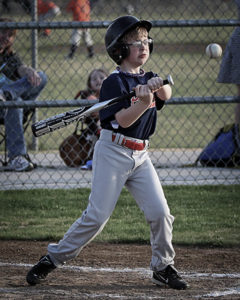
When you throw hitters like this a changeup, you are doing them a favor! You speed up their bat, allowing them to make solid contact. Pitchers in the big leagues throw off-speed pitches and breaking balls after they’ve set up their fastball command.
Scouts primarily want to see good fastball velocity and good fastball command at the amateur level – these two factors matter the most as you move up the levels in pro ball! Teaching changeup grips early can lead to problem number two…
The Changeup Cannibalizes Fastball Velocity
Paul Nyman made this observation many years ago, and I agree with him wholeheartedly. Youth pitchers who rely on a changeup and throw it often in their bullpen sessions will often change their throwing mechanics to get better sink and velocity separation off their fastball. As a result, their pitching mechanics become highly linear and their arm speed decreases due to poor use of rotational force, and this loss of velocity creeps into all of their pitches, including their fastball.
Teaching the changeup early means trying to improve the changeup early. The drive to become “Hamels-esque” in 11U means that you could be missing out on what originally made Cole Hamels, the ability to throw a fastball 92-94 MPH.
This argument dovetails nicely with our motto at Driveline Baseball, which is that pitchers must throw often and not necessarily pitch often. The two skills have a lot of overlap, but as Paul said a long time ago, you can throw a ball without pitching it, but you can’t pitch a ball without throwing it. Pitchers must master solid throwing mechanics as they develop over the years, and by focusing too hard on things like throwing strikes and developing off-speed pitches, they will never develop the elite velocities they need to pitch against post-high school competition.
We detail how to teach youth pitchers good habits, good mechanics and good intent in Hacking the Kinetic Chain – Youth. Youth baseball is filled with a lot of gimmicks and manufactured fear–this buy-once, use-many-times guide lays out a solid, smart training plan for your son from 9U to 14U.
Improper Focus on Getting Hitters Out
Mastering a reverse breaking ball (which a changeup more or less is) is a great way to help yourself get opposite-side hitters out. There are two major problems with this at the youth level:
- If you’re a right-handed pitcher, you will face a staggeringly large percentage of right-handed hitters
- If you’re a left-handed pitcher, your uniqueness is usually good enough to neutralize the platoon advantage
So if you’re a right-handed pitcher and you spend your time developing a pitch to get lefties out, you aren’t even focusing on what is most important to get the majority of hitters out that you’ll face in your high school career! Fastball velocity/command are the most important, followed up by breaking ball quality/command. Your off-speed pitch comes much, much later down the line.
Left-handed pitchers tend to focus too much on deception (varied arm angles, a possible injury indicator) or craftiness (throwing change-ups or other off-speed pitches) to get right-handed batters out, rather than simply developing two fastball variants (two-seam and four-seam) and the ability to locate hard fastballs to both sides of the plate and in three vertical locations – up, middle, and down.
So, is the Changeup Bad?
No! Of course it isn’t. However, it’s not the end-all be-all of pitches that youth pitchers should learn to throw. Contrary to what most people will tell you, fastball velocity is still king, while fastball command is the prince. Colleges and pro organizations want to see big fastballs out of solid-bodied pitchers, and they want to know that you can command it to multiple locations to set up your other pitches. Remember, the better your fastball is, the better your other pitches become automatically!
A good training program will take all of these factors into consideration and develop a comprehensive pitching (and throwing) program for progressing athletes regardless of their level of competition.
Comment section
Add a Comment
You must be logged in to post a comment.
Dan -
I think this article is misleading, and most of the negatives you associate with the changeup only exist with poor coaching. A well-taught changeup is thrown with full arm-speed, which will not be “doing a hitter a favor” if he is also coached on when to use it. Even poor hitters develop timing within the course of an at-bat and game; they’ll just start to cheat to make sure their bathead gets to the plate, and cheaters are the ones who get the most fooled by offspeed offerings. Using a changeup, properly, requires reading hitters on a realtime basis, which is much easier against younger and less formidable hitters. Aggressive little league hitters are going to throw their bats on even a poor changeup, whereas weaker hitters in defensive counts are going to “done a favor” with a 2-strike changeup. If it’s a deceptive pitch with the right speed differential, it’s an effective pitch at every level to strong and weak hitters, provided the pitcher/catcher/coach call the right game.
admin -
Most coaching is bad coaching, Dan! This is something you should certainly understand.
As for “full arm-speed” changeups, this is a myth. Kinematics and kinetics repeatedly show that pitchers with elite fastball velocities (mostly in college and pro ball) have slower arm speeds on their changeups. The idea that the kinetic chain being broken in the wrist/fingers with the ball being held deeper is enough to create a large separation between the two pitches is simply false; a slower rate of internal rotation is required to get this separation. (See any of ASMI’s research for validation)
And as I said in the article, changeups are great – and even necessary to succeed at higher levels of baseball. But they have the potential to do far more harm than good at the youth level.
I brought my data to the table with MLB PITCHf/x data backing it up, and I would find it hard for you to deny that youth hitters have a very high swinging (and missing) strike percentage on above-average fastballs.
Dan -
Well, regardless of whether “full arm-speed” is truly full, it’s still the most important factor in a changeup, one which still deceives the hitter even if only 95%, or whatever. “As full as is possible,” then, still does the trick. It’s irrelevant if Cole Hamels’ changeup arm speed is truly as fast as his fastball, when he produces the effect that it is.
Michael Pineda, SLAP Tears, Forcing a Change-Up, and Pitching Mechanics | Driveline Baseball -
[…] I said it on the Pro Ball NW podcast about training, and I said it in a previous article about teaching youth pitchers how to throw a change-up.Paul Nyman made this observation many years ago, and I agree with him wholeheartedly. Youth […]
Darryl Barnes -
This argument makes sense to me. I’ve got a 12yo who has worked hard to get from below average velocity to average. I can see that spending a lot of time working on the changeup would affect his motion over time and potentially make him less explosive when it counts. I’m still going to continue working on it with him a bit but to be used rarely during games. For him, the most important thing right now is getting him bigger and stronger. Learning different pitches is pretty far down the list for us.
Scott Sandusky -
The piece is certainly on brand but it’s incomplete as a result. Driveline lives on the fringes where most people can’t operate. When a good portion of the piece is about missing bats, you entirely miss the point of even an average change up. I understand that your target demo is aspiring big leaguers but you’re the one who wrote the piece about kids and change ups (statistically almost none of them will play in HS let alone beyond). In the same piece, you didn’t even mention that a change up’s primary mission is to miss sweet spots (draw weak contact), disrupt timing, and enhance perceived velo of the fastball. Even bad change ups work against young hitters of all skill levels.
If you’d like for young kids to get off the field more quickly by making outs, you shouldn’t be asking the question in the headline. You should be advocating that it be taught correctly even though it’s difficult for a small hand to master.
Tracy -
I have a team of 11u players that will tee off on a pitcher only throwing fastball, even if the pitcher can locate. (As well as a 11u can locate consistently) So what would the alternative be if you’re saying changeup isnt the way to go? More curve or sliders?
Driveline Baseball -
At Driveline, development is the main goal. We see that with youth pitchers they often rely on slowing their arm down to throw the change up. We want our youth athletes to learn how to throw with high intent to a spot, recruiting the whole body to execute the pitch. Younger athletes are usually not able to grip a changeup in a way that will decrease the speed 4-5+MPH, so they compensate by slowing things down. We see little leagues get dominated by good breaking balls but again, doing everything you can to win (throwing all breaking balls) is not always in the best interest of the athlete’s long term development. You can read more on youth athletes throwing curveballs, here.