Weighted Baseball Training for Pitchers – A Get Started Guide
UPDATE: How do I get started training with weighted baseballs? Be sure to get the Free Weighted Baseball Program on our site–it’s a simple 8-week year-round starter program!
At Driveline Baseball, we constantly test training and recovery implements for our pitchers. Most won’t surprise you – we use free weight training with barbells and dumbbells, medicine balls of varying weights for rotational exercises, a chin-up bar for pull-up variations, sled push/pull interval training for energy system development, resistance bands of varying tensions to improve stability/mobility and to provide accommodating resistance for more advanced lifters, and lots of other techniques like high-speed video to analyze someone’s mechanics for flaws.
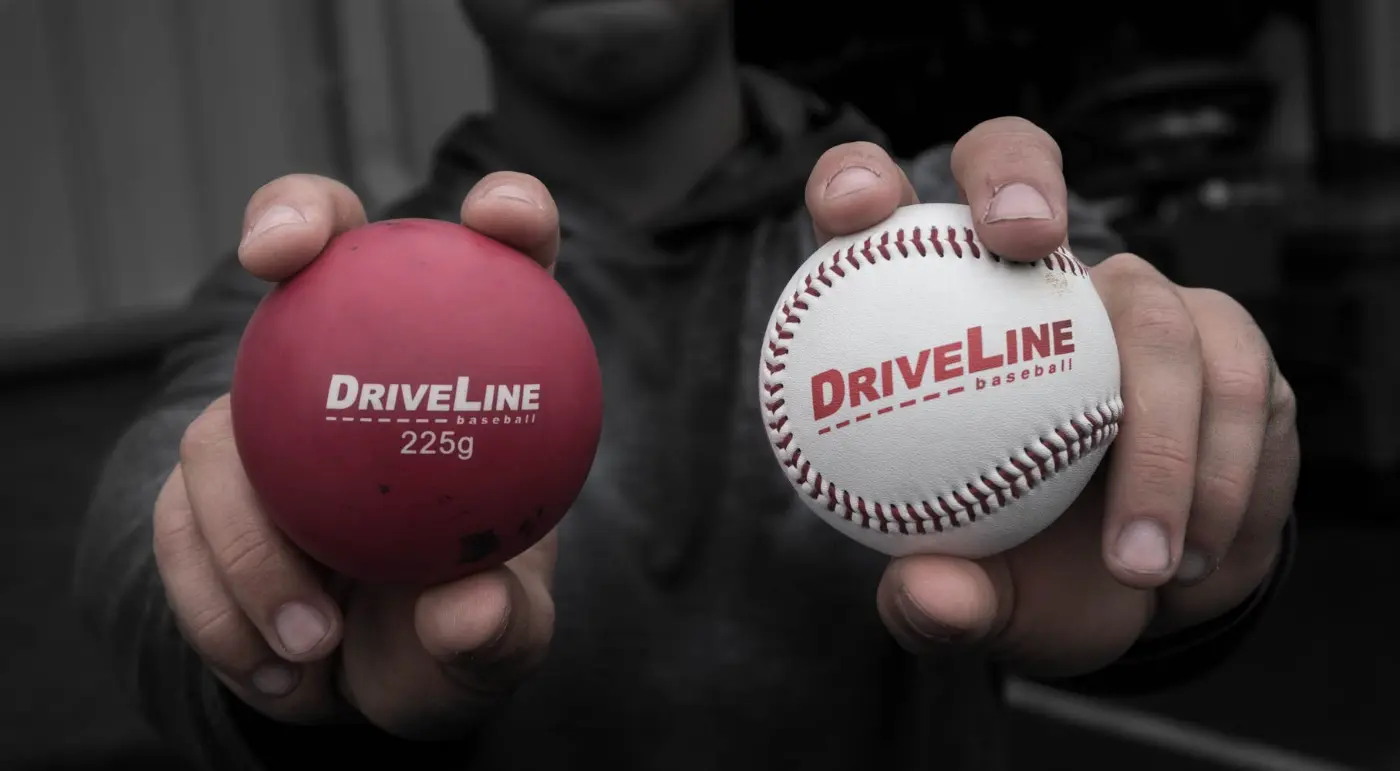
However, a misunderstood training tool that we use is weighted baseballs.
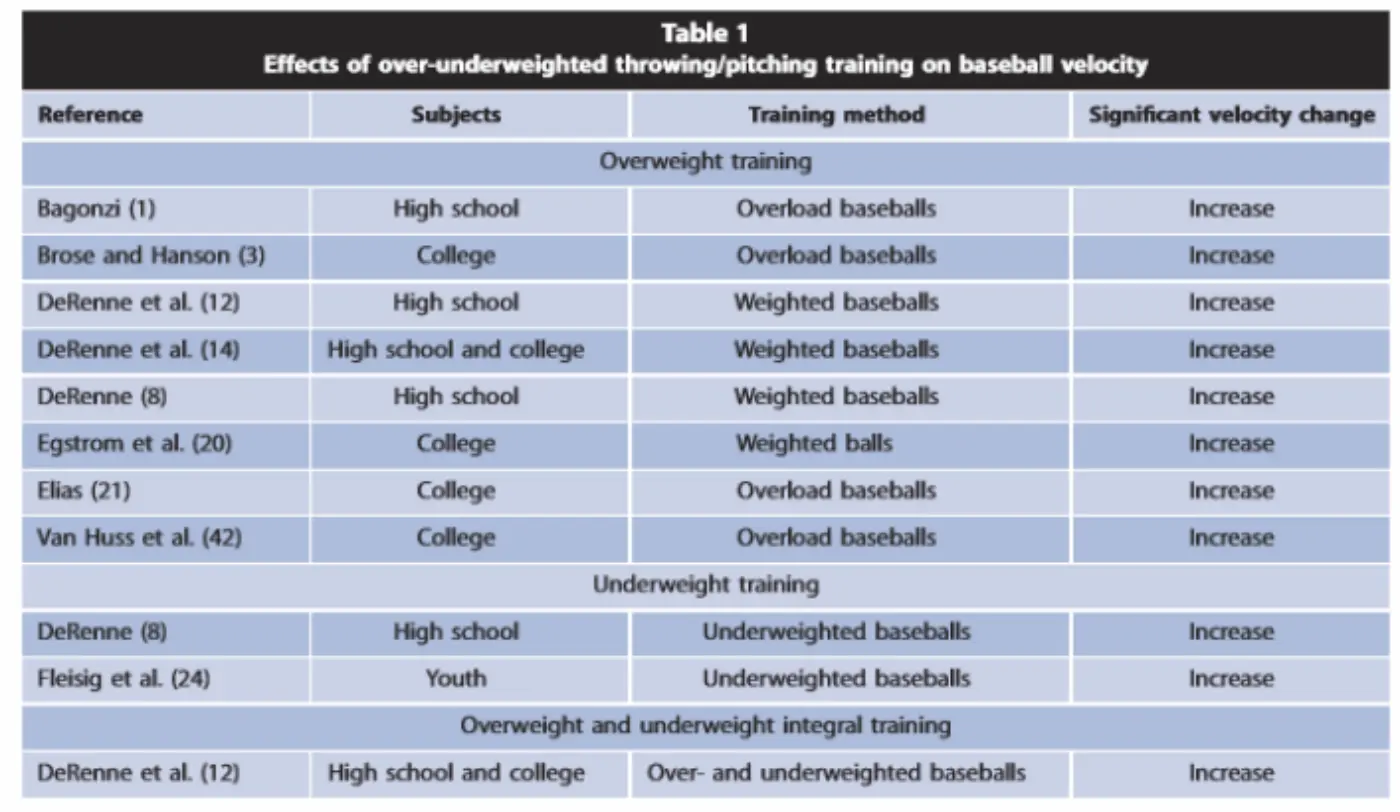
Research backs up the use of underload and overload training in various forms, and it’s no surprise that it works for baseball pitchers as well. Dr. Coop Derenne is the foremost expert in this field and has published a number of research papers that indicate that weighted baseball training creates a significant increase in velocity for those training with underweighted and overweighted baseballs. His most popular paper is Effects of Under and Overweighted Implement Training on Pitching Velocity, which concludes that training with either underweighted (4 oz) or overweighted (6 oz) baseballs improved pitching velocity when compared to simply throwing normal baseballs.
How do you implement weighted baseballs in your Pitching Program?
Like most coaches who do weighted baseball training, we don’t train too aggressively with them until athletes have gone through our initial evaluation, both movement and performance screens, to determine shoulder/hip imbalances and pitching mechanical efficiency. Additionally, our athletes aren’t typically throwing weighted baseballs in-season and only throw them when they have a solid throwing program under their belt. No getting into the weighted ball throwing when they’re cold and throwing 80-85% of their max velocity off a mound!
After we’ve qualified a pitcher to use these implements, we design a program around their age, skill level, bodyweight (very important for recovery purposes), fastball release velocity, and mechanics. We are generally more aggressive with guys who are older and have more refined mechanics – especially if they’ve gone through multiple high-speed video analyses in our Pitching Program. (Athletes who have had their pitching mechanics biomechanically analyzed in our lab can see a lot of improvement with a more specific plan, and we recommend it to all pitchers over the age of 16 who are seriously considering college or pro baseball.)
A typical program for an 18-year old high school senior about to enter college baseball will be throwing batting practice once or twice per week and one short bullpen once per week. On his bullpen days and possibly on one of his batting practice/light throwing days, we’ll have him throw weighted baseballs using a truncated motion that focuses primarily on shoulder rotation. The mechanics in our “Pivot Pickoff” 3 lb. medicine ball drill is similar:
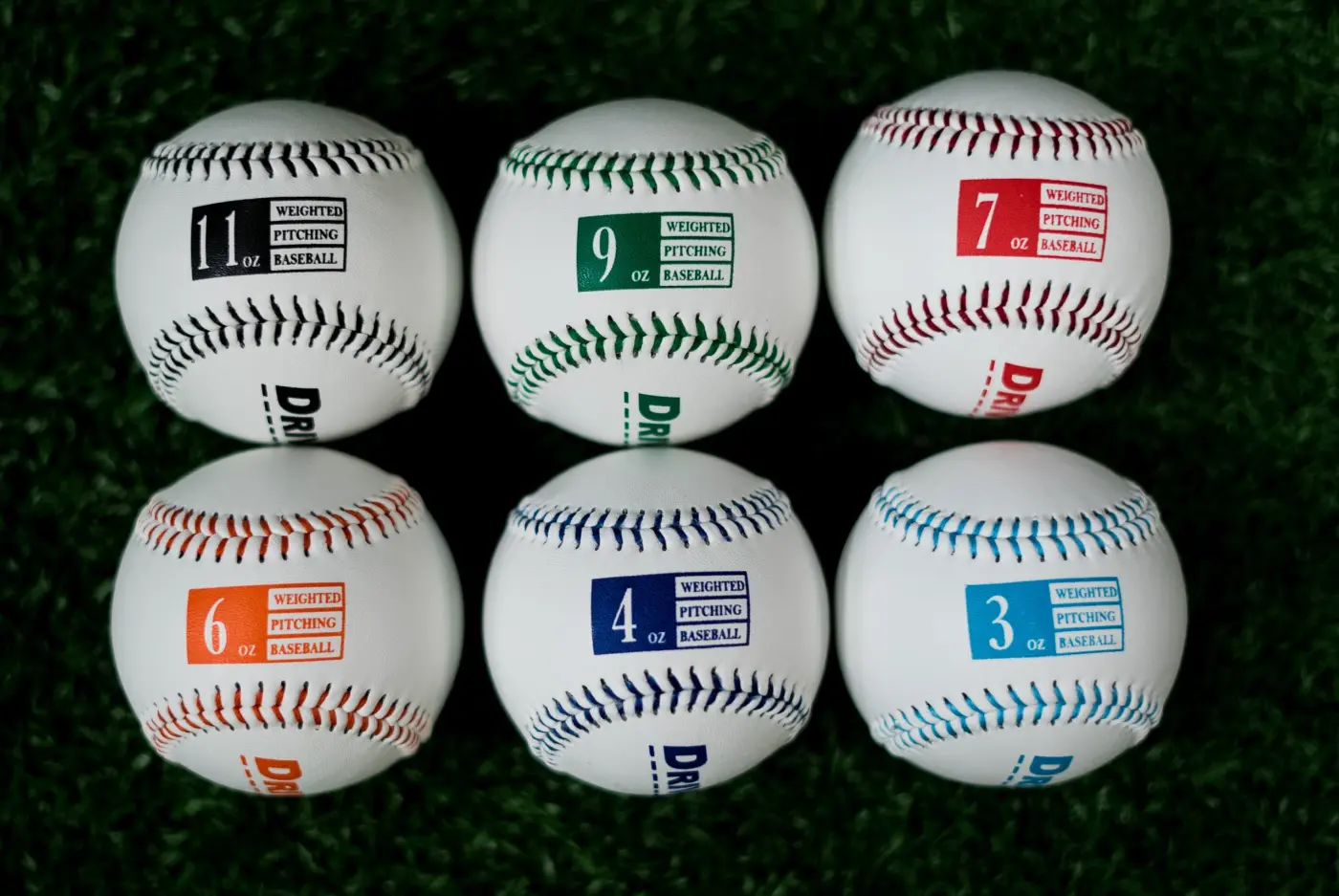
Obviously the pivot pickoff drill focuses mostly on the out-front portion of the pitch while the 3-11 oz. baseballs will more accurately reflect an actual pitch.
What’s the typical throwing progression with the weighted baseballs?
When throwing with a full mechanic off flat ground or the truncated motion to focus on shoulder rotation we’ll go as light as 3 oz and as heavy as 7 oz, which runs counter to what most people recommend. Many sources will tell you to stick to +/- 20% of the original implement’s weight (5 oz), but these recommendations are based off of Soviet shot-put research and not baseball-specific research.
We do not throw weighted baseballs off a mound, as arm-related stress increases when throwing off a mound and when using weighted baseballs – combining this much torque is not something we play around with lightly!
Update 7/22/2017: Recent research by ASMI found that throwing weighted balls off a mound results in similar elbow torque to 5 oz baseballs. It found that 6 & 7 oz balls were less torque than a 5 oz ball, while the 4 oz ball resulted in similar torque to the 5 oz. You can read more about that study and our analysis of it here. Because of that, and other research, we are experimenting with throwing weighted balls off a mound.
A typical weighted ball progression for the aforementioned 18-year old high school senior might look like this:
Weeks One and Two – 39 pitches, 2 sessions per week
- Four throws with standard baseball (5 oz)
- Four throws with overweight baseball (6 oz)
- Four throws with overweight baseball (7 oz)
- Three throws with standard baseball (5 oz)
- Four throws with underweight baseball (4 oz)
- Four throws with underweight baseball (3 oz)
Weeks Three and Four – 52 pitches, 2 sessions per week
- Five throws with standard baseball (5 oz)
- Five throws with overweight baseball (6 oz)
- Five throws with overweight baseball (7 oz)
- Four throws with standard baseball (5 oz)
- Five throws with underweight baseball (4 oz)
- Five throws with underweight baseball (3 oz)
Depending on how the athlete is progressing, we’ll switch it up going forward – generally we add more repetitions, but it can depend on how his progress in the weight room is coming along or where he is at in the off-season. This training is all on top of the free weight training, anaerobic energy development, medicine ball throwing, and throwing-related PlyoCare ® drills – a topic we cover extensively in our training guides.
A full off-season and in-season weighted ball velocity program, based on the best of what we’ve researched, is available in Hacking the Kinetic Chain.
Want to train with us? We have options for local and remote athletes.
The Final Scoop
Weighted baseball training can be beneficial for a lot of baseball pitchers out there. However, I would caution against blindly running to them as a tool to gain velocity. In my opinion, pitchers should build up a reasonable amount of strength in the gym and ensure their shoulders are adequately stable before getting into a training program that is necessarily going to increase torque and maximum external rotation (MER) in the athlete’s delivery. Find a pitching coach who can assess your shoulders and safely on-ramp you into an aggressive training program.
Pick up a set of Elite Weighted Baseballs today and get started on our Free Weighted Baseball Program!
Comment section
Add a Comment
You must be logged in to post a comment.
Hacking Your Arm Action Using Weighted Balls -
[…] Weighted baseballs can be controversial. I get it. If throwing a regulation 5oz ball leads to insane injury rates amongst pitchers, even at the highest levels of the game, the thinking goes, then, that heavier balls must equal more stress, stress is BAD, and injury rates would be higher. Furthermore, there is a fear that weighted implements might actually screw up a pitcher’s arm action, since they have become accustomed to throwing a regulation ball their whole life. Unfortunately, these interpretations fail to understand both the basic mechanism of adaptation to stressors and the actual biomechanical outcome of throwing weighted implements. […]
Kyle Harris -
Good finish on your post. Research actually shows the opposite, that forces and torques on the shoulder and elbow are less when using weighted balls and equivocal when using under weighted balls
Escamilla, R. F., Fleisig, G. S., Yamashiro, K., Mikla, T., Dunning, R., Paulos, L., & Andrews, J. R.
(2010). Effects of a 4-week youth baseball conditioning program on throwing velocity. The
Journal of Strength & Conditioning Research, 24(12), 3247-3254.
Fleisig, G. S., Diffendaffer, A. Z., Aune, K. T., Ivey, B., & Laughlin, W. A. (2017). Biomechanical Analysis of Weighted-Ball Exercises for Baseball Pitchers. Sports Health: A Multidisciplinary Approach, 9(3), 210-215.
Driveline Baseball -
You are correct. We have updated that article to clarify that. Thanks!