Posts Tagged velocity development
Velocity Development Program (MaxVelo) Study Data and Conclusions
Posted by Kyle Boddy in Research, Training on May 1, 2013
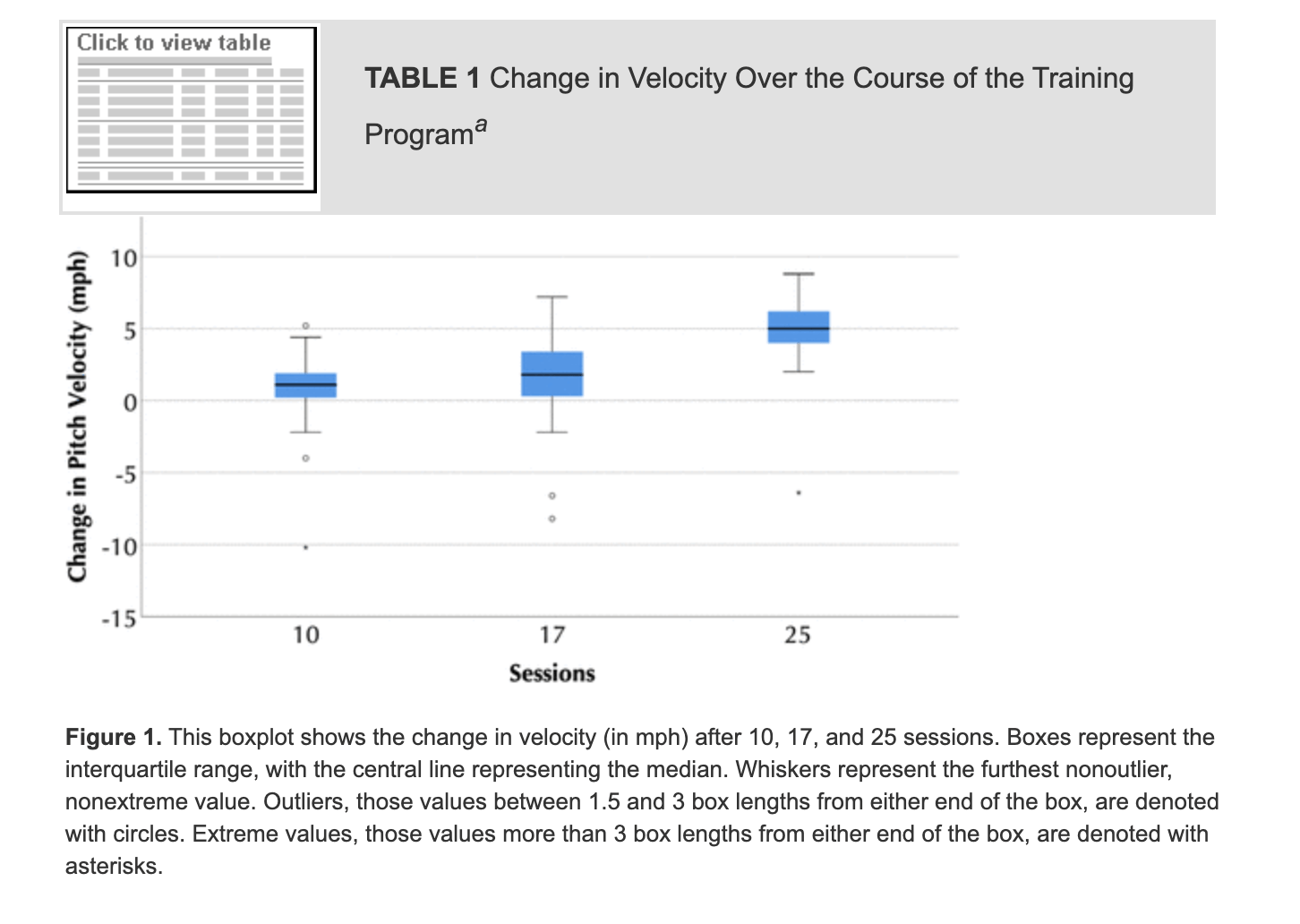
All around the Internet, you can find people with pitching programs that claim to improve velocity and arm strength – including the MaxVelo program, which is our in-house program. However, most of the programs just have average velocity gains for a given population without a ton of detail given. I’ve always been a proponent of publishing as much data as possible, so I plan on doing just that today.
At RIPS Baseball, I was lucky enough to influence the throwing program for many of our athletes. Additionally, there were a group of athletes who followed their own throwing program, or didn’t do one at all. This gave me three groups of athletes to work with:
- Control Group: Did their own thing (usually nothing, or very little)
- Basic Group: Standard throwing program (detailed later)
- MaxVelo Group: Advanced velocity training
The Control Group did their own thing. This was usually limited to bullpens, some band work, and their own weight lifting.
The Basic Group included athletes who did not miss more than 20% of their workouts, and performed basic strength, conditioning, and velocity development work developed by me. Here’s an example of a workout:
- Warm-Up (Wrist Weights, Band Work, Foam Rolling, Dynamic Stretching, Boxing Bag Punches)
- Resistance Training (Squat Variant, Single-Leg Work)
- Plyometric Work (Skaters w/ Medball, Box Jumps)
- Corrective Exercise (Pallof Press, Side-Lying External Rotation)
- Throwing Program (Indoor Long Toss Variant, +/- 20% Weighted Baseball throws [4 and 6 oz])
- Cardio Finisher (Kettlebell Swings, Tabata Timing)
Basic Group weighted baseball training rarely exceeded 9 oz. baseballs on the overload side and never exceeded 3 oz. baseballs on the underload side. (They performed a weighted baseball throwing routine that was very similar to the Free Weighted Baseball eBook that I published in 2011.)
The MaxVelo Group included our advanced velocity development training methods, which are well-documented throughout this site, as well as our extensive YouTube channel. Examples of training include, but were not limited to: Connection Ball Training, Advanced Deceleration Training, Plyometric Training, Reciprocal Stress Training, High-Speed Video Analysis, Rhythmic Stabilization Methods, etc. Again, only athletes who made 80%+ of their workouts were included, though none had to be cut from this group for qualification.
Merry Christmas and A Look Back
Posted by Kyle Boddy in News on December 25, 2012
From everyone at Driveline Baseball (all one of us), we wish you a very Merry Christmas and happy holidays.
2012 was a landmark year for many reasons, not the least of which were:
- Joe Marsh gaining 13 MPH on his fastball in five months (he came in last week and ended up throwing 97.7 MPH with the 3 oz. baseball, so he’s still got it)
- Merging with and moving into RIPS Baseball
- Moving RIPS / Driveline into our new SeaTac location (which continues to be a process!)
- Debuting our velocity development program: MaxVelo (name to be changed in 2013, so keep an eye out)
- Growing our client base – both local and remote training
Speaking of our MaxVelo program, here’s a quick update on the RIPS clients who have signed up and been tested in their first six-week cycle:
That’s an average gain of 6.7 MPH over six weeks, and every pitcher in the program self-reports significantly healthier and stronger feeling arms!
We can’t wait to bring all sorts of new things to you in 2013, including our velocity development program (including videos, manuals, and a significant online component), expanded remote consultation options, more high-speed videos on our YouTube channel, more results from our biomechanics lab, and most exciting, a Driveline Baseball branded line of equipment for training! Yes, you read that right – our own equipment for velocity development and arm care manufactured to our specifications! Since we constantly have to piece together our kits from various places, we’re cutting out the middle man and doing it ourselves, and we couldn’t be more excited to bring those products to market! We hope to do so in February-March of 2013, right before the velocity development program is released (mid-April release date).
So thanks for sticking with us, and supporting us by linking to us and sharing our blog posts on Facebook/Twitter/Google+ and the like. We couldn’t have done it without your help.
Supramaximal Training with Weighted Baseballs
Posted by Kyle Boddy in Mechanics, Video on July 30, 2012
I’ve just found out through some of my contacts that a few notable coaches are no longer using heavy baseballs in their velocity development training programs, so I asked around to confirm it. After doing a bit of research and questioning, I decided to make a video on why we’ll continue to use heavy and light baseballs to replicate game stress that can’t be found in a training facility or your long toss fields (generally).
Take a look and tell me what you think!
Making the Sabermetric Argument for Increasing Fastball Velocity
Posted by Kyle Boddy in Sabermetrics on May 12, 2012
In talking with major league executives, I often tell them: “What would it be worth if you could restore the velocity of guys who are dropping off, or improve the velocity of organizational players?” They all respond with: “Oh, a lot. For sure.”
However, I never could get a dollar figure out of them, and I hadn’t done any research myself, so I decided to roll up my sleeves and do a little educated guesswork on my own. Here are the given variables for a starting pitcher in the major leagues (loosely based off a former pitcher in the last 5 years with middling/decreasing velocity who ended up out of baseball last year):
- FIP Constant 3.12
- Pitcher is a right-handed starter
- Peripherals: 24 GS, 255 FB, 28 HR (11% HR/FB), 50 BB, 2 IBB, 7 HBP, 120 K (7.2 K/9), 150 IP (6.25 IP/start) - 5.02 FIP
- Park Factor = 100 (neutral)
- League Average FIP = 4.80
- Replacement Level Win% for Pitcher = 38%
- 86 MPH average fastball velocity
This pitcher isn’t very good for MLB standards, posting a 5.02 Fielding Independent Pitching (FIP) stat. (For more information on FIP, check out the Fangraphs library.)
We’re going to assume he is sick of being bad at baseball since he’s being threatened with demotion to AAA if he doesn’t figure out how to produce better on the mound. He thinks about how he’s going to improve, and does some hard thinking. In the off-season, he finds someone who will work with him to restore his once-great fastball velocity to where it was in college – 90 MPH. Let’s say that this person’s program increases the pitcher’s average fastball velocity by 4 MPH, going from 86 MPH to 90 MPH heading into the season.
How Will His Peripherals Change?
Here are some educated guesses based on sources I’ve found on the Internet:
- 86 MPH -> 90 MPH (4 MPH difference)
- 0.165 * 4 = 0.66% decrease in HR/FB (http://www.fangraphs.com/fantasy/index.php/does-fastball-velocity-influence-a-pitchers-hrfb-ratio/)
- 0.316 * 4 = 1.264 increase in K/9 (http://bezdomnybaseball.blogspot.com/2010/02/how-do-you-know-hes-unhittable.html)
- 10% reduction in FB rate (http://www.beyondtheboxscore.com/2010/12/23/1890969/ground-balls-and-pitch-speed-what-should-we-expect-to-see-from)
Now, remember, these studies aren’t perfect, but they’ll give us a baseline of improvements the pitcher can expect to see if his velocity improves. You can adjust them downwards or upwards based on your own thoughts/biases if you like.
We’ll hold his innings pitched and games started constant, even though if he got a lot better, he’d probably pitch more (and deeper into games). We’ll also hold his walks, hit batters, and intentionally walked batters constant. As such, here are his new peripherals:
24 GS, 230 FB, 24 HR (10.34% HR/FB), 50 BB, 2 IBB, 7 HBP, 141 K (8.464 K/9), 150 IP (6.25 IP/start) – 4.39 FIP
A 4.39 FIP is decent – it represents a 12.5% improvement from the year previous.
It’s About the Money
So we’ve calculated that this pitcher’s FIP would improve from 5.02 to 4.39, but what does that mean when it comes to how much money it’s worth to the parent organization?
Assuming that the league average FIP was 4.80, the pitcher’s Wins Above Replacement (WAR, using Fangraphs formula) for the first year would have been 1.476, meaning he was worth about 1.5 wins more than a replacement level (good/very good AAA but bad MLB) player. If you take a quick shortcut and say each WAR is worth $5 million, the player would have generated $7.38 million in revenue for the club. Not bad, since he’s close to the league average in FIP, but he’s been regressing and the club expects him to be worse, meaning his value will continue to drop.
However, with the player’s improvements in the off-season, his new WAR would be 2.683 – and using the same WAR valuation, this player would actually improve his value to the club to the tune of $13.42 million for his performance. This means that the club picked up an additional $6.04 million as a result of his fastball development in the off-season – and more than one WAR in the process, possibly putting them into the playoffs and generating more revenue that way.
(Raw data / calculations and formula can be found in the comments.)
Conclusion
What would it mean to a club to have two guys per year add 2-4 MPH on their fastball at the middle/higher levels of the game? I think this exercise shows how valuable a velocity development program inside the player development branch of an MLB club could be.