We don’t just care about bat speed at Driveline and Jordan Walker is evidence of that
There is no doubt possessing bat speed is a crucial trait for a professional hitter.
The math backs the core Driveline development tenet. Bat speed enjoys a strong correlation with on-field hitting performance. This is an empirical truth.
The idea that bat speed matters is hardly a new idea – Babe Ruth, Ted Williams and Hank Aaron all had plus bat speed – but we can quantify it today thanks to modern tech.
And if we can measure something, we can train it. Training and improving bat speed is a core focus in what we do to help hitters.
But that is not the only thing our coaches do.
We also train bat paths, contact points, and hone approaches. If players need to add strength or mobility, we focus on that as well. Training is comprehensive and individualized.
Consider the case of St. Louis Cardinals outfielder Jordan Walker, one of the season’s top breakouts and another Driveline success story.
When Walker arrived at our facility early last offseason to train with Andrew Aydt, now coaching with the Washington Nationals, he did not have a bat speed problem. Walker already owned elite underlying power as seen in his average 78 mph bat speed last season, which ranked at the 99th percentile.
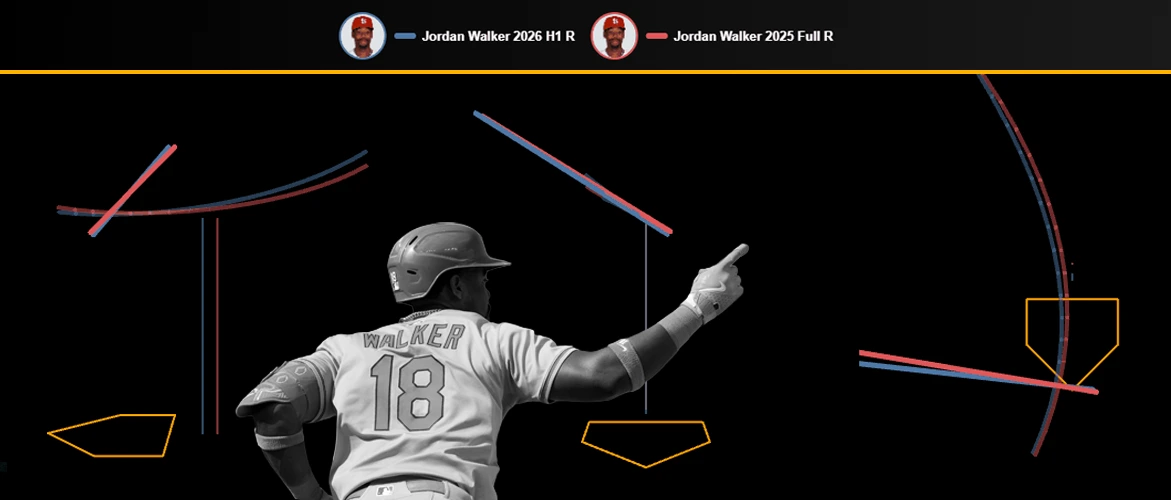
Bat speed was not a focus with Walker, rather, it was his bat path – and how he was arriving to that suboptimal path.
At the beginning of the offseason, Walker visited our Launchpad and had a full analysis done of his swing. He wanted to understand why his underlying bat speed was resulting in below-average results including a second percentile expected batting average and 16th expected slugging last season in addition to poor traditional measures.
What Walker learned was that he suffered from a mechanical inefficiency. And once identified, he began fixing it at Driveline and, at Cressey Sports Performance where he also trains.
“It was really how forward I was coming when I was hitting and what we learned is that when I’m hitting off my backside, I’m driving the ball in the gaps way more consistently,” said Walker to reporters of what he discovered at Driveline. “(Now) I am not rolling over. I’m not getting that top spin on the ball. The focus is really how far back I’m onto my hip, and how I’m hitting on my backside rather than me focusing on launch angle.”
Interestingly, his previous focus on launch angle had led to poor results. It took an understanding of flaws to reach a better physical outcome, a better swing.
This season, Walker’s average bat speed is down a tick to 77 mph – though still very much elite – but his average attack angle changed significantly, increasing from 6 to 9 degrees. The percentage of time he is taking an optimal angle with a swing is up to 60% early this season compared to 48% last season. He’s dropped his ground ball rate by 15.5 percentage points to 32% this season, which is the eighth greatest decline among hitters with at least 300 plate appearances last year.
We want a hitter like Walker to get the ball in the air often.

The following video includes a look at some of what Walker did with our staff behind the scenes, including step backs with short bats and game bats:

Walker did not require a total overhaul. The changes and prescriptions were straightforward once identified in the lab, and they have led to big results:
But they had nothing to do with bat speed. They had to do with bat path, contact point and how his body created that.
“If I’m moving correctly, then the launch angle, and exit velo, and driving it where I want to – it will come up with it,” Walker said.
There are plenty of other stories like this.
Consider what Driveline director of hitting Tanner Stokey told me when evaluating how many clubs in a bag a hitter should carry, using the golf analogy.
“As much as we talk about bat speed and pulling the ball in the air, you’d be pretty surprised how many times we hit it hard and low to the opposite field,” Stokey said. “Backing up the point of contact, catching the ball deep, and sequencing well enough to be able to maintain posture and get the barrel on plane behind it… Hard and low to the opposite field – it’s going to help them reverse engineer a way to have a good efficient path to when they catch the ball out in front.”
Rockies outfielder Jordan Beck told me of his Driveline experience that he “learned about other avenues that I don’t know well, or don’t understand” – including that his bat path was too steep entering the zone.
“It was like I had a shorter window to get the ball in the air,” Beck said. “We worked on trying to give myself a longer window to get the ball in the air. The best guys will get it in the air deep, or, out in front.”
Consider the story of Vinnie Pasquantino working with Aydt at Driveline last year.
Pasquantino had attempted to adopt modern, optimal practices in baseball that included adding bat speed, and more often pulling the ball in the air to his pull side.

But he’d perhaps taken it too far.
“He was pulling the ball in the air with fewer ground balls but there’s no results with it,” Aydt told me in the fall. “And that was mostly just because he was pulling it too much, his spray angle and direction was too far on the pull side. There was an actual interview with MLB Network in the middle of (last) April. He talks about how (he hit) a ball 108 (mph) over there and points towards the dugout. So, his direction was just too pull happy, essentially, and so that’s one of the things we identified… He was kind of over rotating… We changed a few mechanical things, but it’s mostly about getting him to work back to the middle of the field.”
The adjustment to get the Royals first baseman to think more middle of the field played a role in his breakout season. It’s another story that had little to nothing to do with training bat speed.
Now, we care a lot about bat speed but that’s not our only focus. Hitters still have to make quality contact with a pitch, or their underlying engine is of little use. We are focused on the total package, individualized training, and for Walker it wasn’t about moving faster, it was about moving more efficiently.
Comment section