Antone’s return from a third TJS is providing hope and a road map for arms
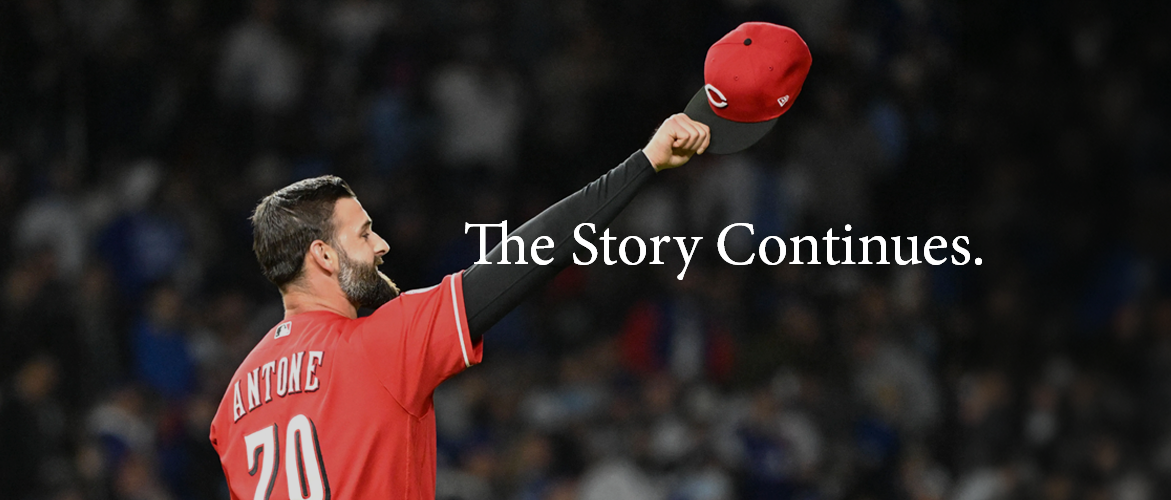
On April 7 2024, at Great American Ball Park, Tejay Antone felt an all-too-familiar pop in his right elbow.
His first pitch of his fourth outing of the season sailed wide to open the sixth inning. There wasn’t a cracking sound like stepping on bubble wrap. Antone says it’s hard to explain. It was more like muffled, untethering within his elbow. Antone hopped immediately after his follow through was complete on a sunny get-away afternoon.
What was strange is there was no immediate stabbing pain like with his first two injuries, rather, an eerie absence of it. He did not yelp out but he couldn’t straighten his arm.
Soon the training staff congregated.
The awfulness of the day was hard to fathom.
Antone’s wife had just suffered a miscarriage. He was emotionally spent and now physically broken again. Perhaps he should not have pitched that day, but he did not know what else to do with himself.
By the time the long-time Driveline client reached the clubhouse, he was already rehearsing the retirement speech in his head.
“I’m done. I don’t want to do this anymore,” he thought to himself.
“That was a very, very low point in my life,” Antone said. “It was just incredibly sad: career ending and life ending. It was just a lot to carry on my shoulders. And that’s one of the reasons I was just ready to just like check out and retire, like, ‘I do not want to do this anymore.’”
He knew he was at a crossroads.
When he met with Reds team Dr. Timothy Kremchek a few days later, the injury imaging was so severe it seemed at first inconceivable he would pitch again. But Kremchek was surprisingly optimistic: the news was so poor, it was almost good. A total rebuild was on the table but it also had to include a better understanding of the root causes.
Out of the 2,741 pitchers to have Tommy John Surgery, according to Jon Roegele’s database, only one other major league pitcher — Jonny Venters — is a direct comp to have endured three Tommy John Surgeries and return to play.
Drew Rasmussen has endured three surgeries, but the third was a hybrid Internal Brace procedure. Jason Isringhausen (age 38-39) had a third elbow surgery, but it was reportedly not TJ.
Venters (age 33-34) pitched 42.1 innings before retiring after his third surgery (5.31 ERA/4.61 FIP).
Antone was faced with quitting or venturing into largely uncharted waters.
Tommy John surgery is something of a miracle. It’s extended countless careers. But multiple Tommy John surgeries creates nearly an impossible obstacle.
There have been 173 such cases and 59.8% have not returned to play. Those that did return generally had diminished ability.
Why is it so difficult to return?
I asked orthopedic surgeon Jeffrey Dugas — a pioneer of UCL repair with Internal Brace surgery — last year why having a second TJS reduces the chance to return and performance.
“You’re putting another (tendon) graft on top of an already bulky piece of tissue, and that does change how the joint responds, how it creates tension… and holds the joint stable,” said Dugas of repeat ligament reconstruction. “You also have some healing issues because you’ve already drilled the bone and put tendon in there.”
The joint can lose mobility and become less stable.
Kremchek has performed nearly four thousand Tommy John surgeries at his facility in suburban Cincinnati. Kremchek highlights another reason for the failure rates: Father Time.
“We know that the longevity of a Tommy John at this level is about six years. It just is,” he said. “If you’re a 30-year-old pitcher in the big leagues and have it done, and you last six or seven years, it’s retirement age (if facing a second).”
One thing going for Antone? He was young to have a second Tommy John, let alone a third, at age 30 in 2024. He had more time remaining than many arms.
How have the surgeries changed the inner workings of his arm?
Antone’s first surgery on April 5, 2017 was “pretty straightforward,” he said.
He tore his UCL, and tunnels were drilled — two in his ulna and three through his right humerus to create a triangle tunnel configuration – through which to attach the new ligament graft. He did not have any other related issues.
His second surgery was more complicated.
That injury included an avulsion fracture, which is when a ligament or tendon pulls a fragment of bone away from its main structure. These injuries often occur after a Tommy John surgery as bone breaks from where the tunnels had been drilled in the initial surgery, weakening the bone. He also had a partial UCL tear.
“So, they tried to go in there and stitch that back down, drill the new hole, and reconnect the UCL,” Antone lamented. “Obviously, the second one didn’t work either. There were some issues with it. I think I was getting some fraying from where that bone broke … where the flexor was sitting on top of that broken bone – not broken anymore, but the fracture of where it was. I think there was some kind of friction happening there, which makes sense.”
That repair held for four years and four months before failing in spectacular fashion.
The MRI last spring revealed the flexor mass had ripped completely off the bone, taking a sliver of his humerus with it. There was no sharp pain because the pain receptors were torn away. The UCL had come loose again, though not torn this time. It was completely detached, freed like a rope that had finally slipped its mooring.
Should he even try and pitch again?
Said Kremchek: “I sat down and we had a heart to heart, tears on both ends.”
But what surprised Antone was how Kremchek remained optimistic even given the severity of the injury. One reason? Kremchek thought they had identified one recurring issue they could address with surgery and rehab: weakness in his flexor mass.
“We can fix the ligament, but I think fixing this flexor mass and getting this to heal properly will take the stress off your ligament and give you a great chance to come back and play,” Kremchek recalls telling Antone. “But I said ‘If it doesn’t, and you can’t come back to play, you can lay your head on a pillow at age 45 and say, ‘I did everything I could.’’”
Antone’s mindset began to become more optimistic. He at least wanted peace of mind. He decided to have surgery. He and his wife also wanted to try and start a family again, and what if, by some minor miracle, his future kids could watch him pitch?
In this attempt, Kremchek said he “threw everything at him the third time.”
Kremchek shaved bone down so that Antone said they could have “a fresh start,” and avoid any fraying. Kremchek drilled new tunnels, and reattached the UCL. He didn’t need a new graft, but he added an Internal Brace for further support. The veteran surgeon added eight anchors to reattach the flexor mass back to the bone, something like rebar reinforcing concrete. For good measure, he also added a collagen patch on top of the ligament to further promote healing.
“Very complex,” Antone said. “A lot going on.”
The repair was a big first step on a long road back. But Kremchek said so much of what got him back to the major leagues was tied to the arduous rehabilitation process, but also evaluating and addressing root causes.
Kremchek said re-injury can often be tied to a pitcher not making any changes.
“I think that was the big difference,” Kremchek said. “At the end of the day, the rehab was going to be extremely important. And in him understanding his mechanics. If he was going to come back to this level in the game, he’s going to have to fix something.”
Antone would reevaluate how he threw, and what he threw.
When he was well enough to throw again, Antone made his way back to Driveline for an evaluation.
Driveline’s Brett Cook led the assessment last offseason.
“Something that did stand out to me with Tejay was his willingness to push himself during his assessment,” Cook told me. “He wasn’t afraid to rear back to fire some fastballs, and obviously he isn’t afraid today, which has played a huge role in his ability to get back to the big leagues.
“As far as the biggest challenges go from coming back from multiple Tommy Johns, I’d imagine the psychological hurdle absolutely has to be the biggest hurdle. As an athlete, you absolutely have to put trust in yourself and in the process that you’ve followed in order to compete at the highest level. I can only imagine how difficult it can be to trust that everything will stay intact after multiple TJs.”
What Antone did not have was any joint mobility issues.
Antone said he’s learned over the years that he’s a hyper-mobile person.
“Joint mobility comes very easy to me,” he explained.
But there were conversations on changing how he threw.
Driveline’s Daulton Barry had great conversations with Antone about how his torso was moving throughout his throwing motion, and brainstormed ways he could improve that with constraint work (which he had long adopted and been open to).
That process began at Driveline and then made its way to Antone’s own gym and training facility.
Antone also maintained dedicated use of our PULSE technology to monitor his workload, which he sees immense value in.
“I love spinning the ball every day, and I think that PULSE is something that holds me accountable,” Antone said. “When I first put the PULSE on (several years earlier), my recovery days were supposed to be something pretty low – a three, four, or five. But what I was coming out with were nines and 10s. I was like ‘What is this?’ And then I understood I was making 30 throws and spinning the ball 10 times. It keeps me accountable.
“The other thing I like is the chronic workload, and understanding I have an allotment… I have my own Google spreadsheet I put my numbers into. ‘Is it smart to go back-to-back, should I take a day off?’ And I can kind of play with those numbers.”
At the end of his assessment at Driveline, and of his own personal assessment, he became a different pitcher after he emerged from the process following his third surgery.
He dropped his arm angle to a career low of 28 degrees.
He’s added a sweeper and cutter.
And after his wife delivered healthy twin boys in early November, the Reds signed him to a minor league contract on Nov. 14.
A Netflix-worthy comeback story was coming together.
“He invented new pitches, new approach, a new arm angle, everything,” Kremchek said. “At that point, everybody’s still skeptical. ‘Hey, man, you’ve had three Tommy Johns, yeah, you’re a good guy and all this, but are we going to take a chance on you?’ I didn’t beg the Reds to do it. I just said it was the right thing to do. I’ve been here long enough that, you know, that I think they heard what I said. I said ‘This is a great guy in the clubhouse. He’s a great guy for a minor league program. He’s a great presence to have’… He loves the game and can only do good things for it. And I give the Reds an awful lot of credit for saying, ‘OK we’ll sign him back and give him a chance.’ Then it was up to him and he resurrected himself.”
He returned as a different pitcher on May 6 – with his wife and six-month-olds watching – with one of the most diverse arsenals amongst all relievers. He was not afraid to ramp up his stuff.
He’s averaging 95.5 mph with his fastball, the best mark since 2021.
His K-BB% rate sits at 16.7% through his first 14 innings, an above average mark.
He’s throwing his slider more than ever (51.2%), his fastball at a low rate (7.4%), his new cutter (21.7%), curveball (14.3%) and a sinker (5.4%).
He was also not afraid to try and raise his level of performance even with so much conversation about the risk of increasing throwing velocity.
“When you really flip the script, you say, ‘OK, why are you wanting to throw harder?’ Well, that’s because the athlete wants to play the next level, whatever level they’re at,” Antone said. “Hard throwers get more opportunities. It’s not unfortunate, but it is inevitable… That trickles down to the minor leagues and moves down to college baseball, and that trickles down to high school baseball. So, up and down, in the game of baseball, just throwing harder, you got a lot more opportunities.
“So, now, when people are saying, ‘Well, you don’t need to throw hard to get outs’ — it’s like (that logic) is from 30 years ago.’”
Antone does not know how many chapters are left in this story – he’s written a book due that is due out this summer about his experience – but it’s a compelling story even if it ended tomorrow. He’s shown the baseball world that multiple serious injuries do not have to be a death knell. Rather, it can be an opportunity to become a different type of pitcher and return to the highest level.
Comment section