How in the heck has Fernando Tatis Jr. not homered yet? A forensic swing investigation

*Editor’s Note: After a 55-game slump and 207 at-bats, on 5/30/2026 Fernando Tatis Jr. finally hit his first home run of the 2026 season.
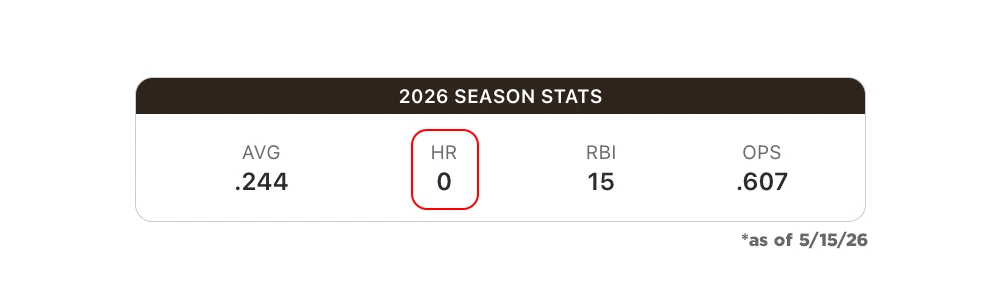
We are a quarter of the way through the major league season, and Fernando Tatis Jr. is yet to hit a home run.
It’s the greatest mystery, the biggest head scratcher of the young MLB season.
This is a player who should be at the height of his powers, he’s of prime age, and one of the sport’s greatest athletes.
In exploring his underlying skills, the lack of a single homer becomes even more baffling.
Tatis Jr.’s hard-hit rate resides in the 98th percentile.
His bat speed is up from last year sitting at 75 mph, also ranking at an elite level — 84th percentile.
His launch-angle, sweet-spot rate is improved from a lowly fourth percentile a year ago, to ranking 60th this year.
Barrel rate? Also strong at 11.7%.
And yet, zero home runs. None.
Tatis Jr. is now 180 plate appearances deep into his season. He’s hit at least 21 in all of his full seasons, including a career-best 42 in 2021.
“I don’t know what the (expletive) is going on,” Tatis Jr. told reporters recently. “But, man, just keep going out there and keep grinding.”
What is going on?
I employed our in-house SamCast tools and spoke with Driveline trainers, to understand what might be going on – and what could help Tatis Jr. end this curious dry spell.
“His fast-swing percentage is the fastest of his career,” Driveline hitting trainer Dylan Robertson said. “We can’t go back to when he was highly productive in ‘21, or beforehand for bat-speed stuff, but I can’t imagine that he was swinging much faster. He is hitting the ball just as hard as he was back then. So, I would definitely think it’s a lot more approach-based.”
The two biggest clues are tied to his batted ball profile.
His groundball rate has spiked to a career-high level (52%), and his pull percentage has cratered to 29%.
Even more important, his air-pull rate – never a strength – has plummeted to a paltry 5.4%. Pulled air balls are, of course, the most optimal batted-ball type in the game.
The only year Tatis Jr. was above average in air-pull percentage was 2021 (22.2%) when he hit a career-best 42 home runs.
While there’s skepticism about Tatis Jr.’s best campaigns because of a later PED suspension, he’s always had elite bat speed. What was really different about 2021 is he lifted the ball into the air to his pull side at the best rate of his career.
This year, among the 288 hitters to produce at least 20 fly balls this season, Tatis owns the third lowest rate of air pull.
What’s going on here?
Tatis closed off his stance more this year, from standing 32 degrees open last year to just 9 degrees this season.
“It almost seems like he’s trying to push balls the opposite way for whatever reason,” Robertson said. “His stance is, I think it’s something crazy like 20 degrees more closed compared to last year. I would say that is the big thing… You got his average point of contact is deeper, his attack angles much lower. I think the biggest thing is, his path is more of a byproduct of that. There’s probably a little bit of an attempt to kind of go the other way, for whatever reason.
“He’s just late.”
As Robertson explained, his setup with his lower half is in part affecting how his bat travels through the zone.
The best hitters have always known the importance of contact locations and optimal paths. But we’re able to quantify the importance of these traits today which, should allow hitters to more quickly break out of bad habits and slumps.
If we can measure it, we can train it – we can improve upon it.
“The biggest thing is like the depth of contact is deeper. The attack angle is significantly lower,” Robertson said. “The direction is significantly further to the opposite field. Unfortunately, we don’t have bat-tracking data from when he was at his best, you know, in ‘21. But even just looking back from the second half of ‘23, his attack angle is cut in half. It was 12 degrees. It’s six now.”
For some reason, Tatis Jr. is doing the opposite of what led him to his best season – getting the ball in the air to his pull side.
As we can see in evaluating SamCast data, so many of his swing traits and metrics are trending in the wrong direction from where they were in recent years.

His downswing’s horizontal attack angle is 7.5 degrees below our optimal target for his swing.
Our model believes his downswing is too steep in its horizontal move. To reach the optimal path, he would need to reduce that angle, essentially keeping the barrel slightly more “inside” or direct during the initial move to better align with the contact zone target.
It’s a measure of swing efficiency and directionality—tracking whether the energy of the swing is being directed toward the ball, or wasted by swinging across the path of the pitch too early.
This is the angle of the bat during the initial “entry” phase of the swing.
Then consider his vertical attack angle (-1.3 degrees) compared to our model’s target of 4.05 degrees. The model suggests he is “dumping” the barrel, or, having his hands get below his barrel too early in his swing. The 5.35-degree difference suggests he should start the swing with a more upward entry to better match the plane of the incoming pitch earlier.
Arguably, the most critical VAA metric is the attack angle in the contact zone as it represents the angle of the bat at the moment of impact.
His current angle is 9.63 degrees, again quite a bit removed from an optimal target of 13.25 degrees.
Most pitches enter the zone between 4 and 7 degrees, so to create a square collision, hitters want to live in the 8-15 degree range. Our model calls for Tatis to try and boost his angle by 3.6 degrees.
His swing plane needs to be cleaned up.
Driveline director of hitting Tanner Stokey said a player like Tatis Jr. is probably not that far removed – modest adjustments – from a major breakout.
But to evaluate a player like Tatis, we don’t want to make too many assumptions based upon the model alone – we want to get the player in for an evaluation.
“In terms of the prescription for cleaning it up, that’s why I’d like to get hitters in the mocap lab. See exactly how he’s moving,” Stokey said. “This comes back to wanting to have as much information as possible on ‘Why?’
“A true motion capture assessment, on force plates, with bat tracking is incredibly impactful because there’s a lot of different things you could focus on with this. But if you could take all that information and figure out, the root cause — the actual underlying issue — that becomes the sole thing to focus on mechanically. And then you’re using all the other information as feedback.”
As Tatis continues to languish, the physical and mechanical issues have likely bled over to becoming psychological.
“I was just watching his at bats from a game from last week,” Robertson said. “I’m watching an at bat in the first inning, and his load looks — and it’s not substantial — but it’s different enough than what he did in the fifth inning. And it’s like, ‘OK, this is a guy who’s actively searching.’
“Obviously, he knows that he’s an unbelievable baseball player and he’s probably pressing at this point. He knows just as much as anyone else that he doesn’t have a home run… He looks lost, right?”
Tatis has admitted as much.
But as dire as it looks now, he might not be that far away from a fix. It could be a darkest-before-dawn scenario.
And with modern tech and data in the feedback loop, and coaching expertise, it should never be easier to fight one’s way out of a slump. For Tatis Jr., this drought is going far too long.
Comment section