No one wanted to train more at Driveline than Trace McDonald and he’s making the most of it
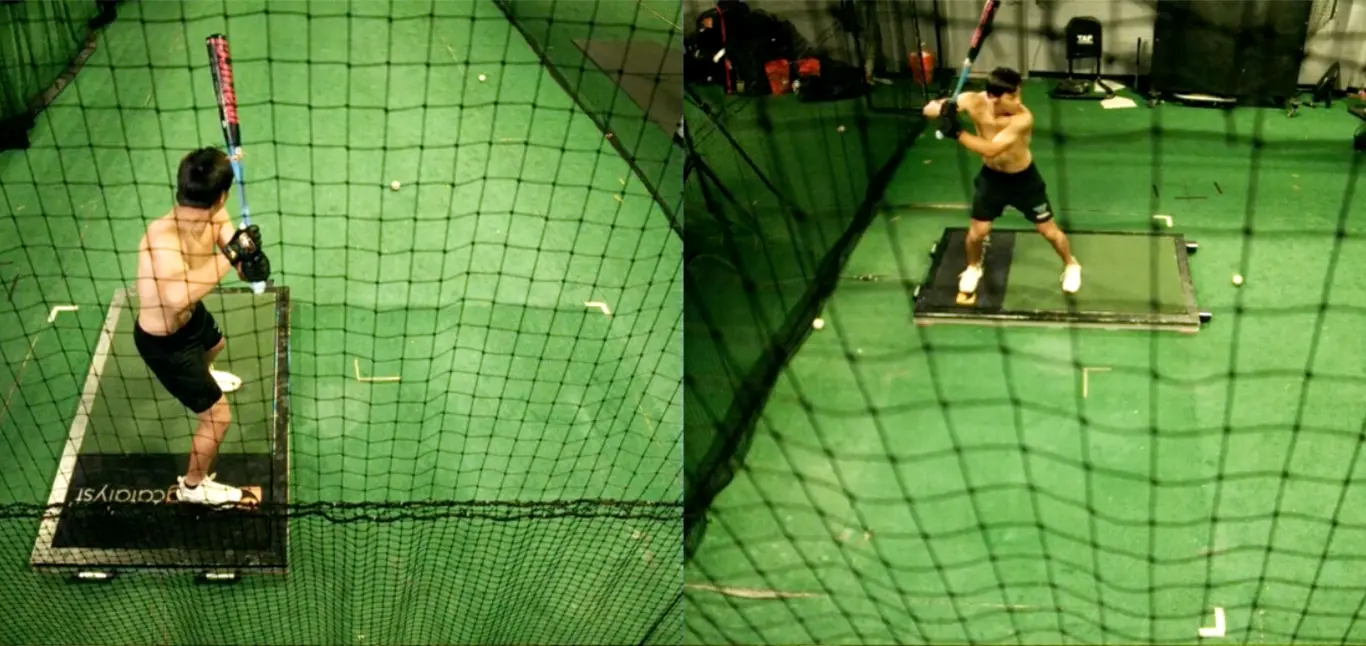
In the seventh inning of their season opener at Cibola High School in Yuma last month, Trace McDonald got his pitch.
He was hunting an elevated fastball all afternoon, waiting and waiting for it, and the opposing pitcher finally obliged.
The junior Highland Hawks infielder fired off his A swing, a collision and metal ping resulted with the ball redirected on a perfect arc.
He floated around first base as the ball disappeared behind the left-field, chain-link wall, which was covered in a green windscreen. Perhaps the ball even bounded onto 18th Ave., beyond the field.
“I was trying not to smile,” McDonald said. “We were winning so I did not want to be too showy. … I knew I got it, so that’s like the best feeling in the world, right?”
McDonald, 17, had never felt that before. Well, at least not as a varsity player.
As a sophomore last season, he did not homer in limited playing time for Highland (Gilbert, Ariz). He played in 15 games for the varsity team and hit .185.
This spring? He’s already slugged three homers through the first nine games of the season, batting .519 through his first 27 at bats.
While many young players struggle to adjust to a higher level of play, like a first exposure to a varsity team, McDonald is also a different player this spring.
He’s beginning to enjoy accelerating growth, a byproduct of his hard work and embrace of modern tech and data — along with a little help from the tools and staff at Driveline. One of the youngest to ever walk in the gym doors, McDonald is beginning to enjoy the compounding effects of data- and process-driven paths to improvement.
His story is just in its early chapters, but his is also an instructive journey to this point – to arrive at this place where he was rounding third base trying to suppress an ear-to-ear smile in Yuma.
The journey started when the world shut down.
McDonald’s father, Brett, had always wanted to help his son become better at baseball. For instance, when the world stalled during peak COVID, they regularly hopped the fence for reps at Cox Sports Park ballpark field in Ladera Ranch, Calif. near their suburban Los Angeles home.
As the co-founder of a basketball analytics company, Vantage, Brett appreciated data-based processes. In exploring ways to help his son become a better ballplayer, he stumbled across Driveline Baseball during some online sleuthing.
They watched a number of the Driveline videos on YouTube to learn training drills and concepts. He improved.
They bought speed trainers to try and coax out some more bat speed.
But Trace wanted more.
Encouraged by the results, Trace asked for a visit to Driveline for his 14th birthday present. They had family in Seattle and they reasoned he could spend a month training there. The problem? When the family was available to travel to Seattle in the summer, Trace was still going to be a few months shy of his 14th birthday in the spring of 2022. Athletes had to be 14 to train at the Seattle facility.
With a little creativity surrounding his birth date – not a first in baseball history – Trace got in the door.
“My dad moved up my birthday,” Trace said with a laugh.
As with most athletes, Trace first had a biomechanical assessment. He had the markers attached to his shirtless body and took some hacks in the lab.

The value of data was apparent immediately. He learned of a major swing flaw he was not aware he possessed.
“I was bending so far forward, my chest was like getting way vertical compared to the ground,” McDonald said. “We just focused on staying a little taller, and being able to turn better.”
Soon after his assessment, he was thrown right into the fire.
On Day 1 of his visit, perhaps the youngest player to ever train at the facility found himself in a hitting group with college and even independent league players facing an iPitch machine.
“It was super intimidating,” Trace said. “I remember meeting an Indy ball guy in my group and thinking like, ‘This guy’s getting paid to play baseball right now and I get to be out here hitting with him.’”
Driveline director of hitting Tanner Stokey was there watching, and because it was so unusual to see a 13-year-old taking hacks off an iPitch, he has not forgotten witnessing it.
“I vividly remember his first day,” Stokey said. “He’s coming in with this group, and it’s like, ‘All right, this kid’s young, he’s very small, he might have been 140 pounds – maybe. This kid is going to get dominated. Maybe we need to make the machine easier?’”
But McDonald did not want any special treatment.
They set the iPitch around 90 mph, Stokey recalled.
“He’s just in there taking G hacks as a kid. He was completely overmatched, but there was zero fear. … It was really cool, you know, it kind of set the tone for what he was going to be like throughout.”
McDonald quickly learned the benefits of the tech and data-based feedback loops at the facility like the biomechanics lab and advanced, game-like pitching machines. He learned how Driveline’s processes and tools are always being iterated and improved upon.
After that initial visit, McDonald’s family moved from the Los Angeles area to Phoenix where McDonald began training at Driveline’s Phoenix facility. He’s regularly taking reps off the Trajekt pitching machines for game-like reps, and building strength in the weight room.


All along the way he’s employed our data-based feedback loops to guide progress. Regression or progression are there in black-and-white fact.
The strength- and bat-speed-building programs have allowed McDonald to break 100 mph in exit velocity with a personal best of 102 mph.
“My bat speed went from barely 60 (mph) to where, now, I am consistently in the low 70s,” he said. “My (personal best exit velocity) went from like, around 80 (mph) my eighth-grade year, to 95 last year, to a personal best of 102. So, slowly moving up. It’s been consistent progress.”
And this spring those gains are beginning to show on the field, not just the gym, for McDonald who wants to go on to play in Division I college. He wants to play the game for as long as he can.
Most athletes who arrive at Driveline like McDonald did three years ago know they are going to experience innovative technology and training regimens, efforts that we are always improving and iterating upon.
But what he could not access from YouTube from afar was Driveline’s culture, which he first experienced in Seattle and now regularly in Phoenix.
“It’s one hundred percent the culture,” McDonald said. “I would say it’s not just about all the cool technology that you see posted, like that’s all awesome. That’s great. But the people here are next level. I’ve worked with the best hitting minds in the world. Some are gone now (in pro baseball) but they taught the next generation of coaches. They’re all great, great coaches. They all know what they’re doing and they’re all going to give you everything they have to get you better. They really do care about you.”
Coaches that worked with McDonald include former lead hitting trainer Conner Watson, now the Guardians assistant director of hitting, Elijah Boyer (now with the Red Sox), Stokey, and McDonald’s new lead trainer Christian Leone.
He learned how Driveline coaches blend real-world playing and coaching experience with an understanding of the latest technologies and best training practices.
“They just teach you how to work the right way,” McDonald said. “They hold you accountable, not in the way that they’re going to be like getting on you for mistakes, but that you want to live up to the standard that everyone else here has.”
They held him to standards but they also became his biggest fans.
When McDonald first hit triple digits in exit velocity in the gym last April, those in the space erupted.
Trace McDonald came to Driveline on July 5th, 2022. On day one, his average exit velo was 68.13mph.
After nearly 3 years of dedication and hard work, Trace had a breakthrough. Not only did he shatter his previous PR with 100.5 EV, but he had another knock off the Trajekt at… pic.twitter.com/1R512Lg4iL
— Driveline Baseball (@DrivelineBB) April 8, 2025
“Boyer went nuts,” McDonald said. “It was really cool. It’s just, you know, I had been working toward that for three years and it finally happened last spring.”
But even with technology that sometimes seems indistinguishable from magic, even with excellent coaching, there is still no substitute for an athlete’s willingness to work – and to work often through failure.
McDonald does not reach that 100 mph exit velocity mark, he does not hit that sky-scraping home run in Yuma earlier this spring if he’s not willing to invest, to work, to grind. There’s no substitute for that.
“It’s not magic. The human element is the hardest code to crack with all of it,” Stokey said. “Because a lot of what we do is, is intentionally designed to make you struggle. It’s challenging by design. A lot of the drill work, the training bats, things like that, we’re intentionally trying to feed into flaws, things that force you to make some changes, drive those adaptations over time. So, you have to be willing to struggle, which is not easy for a human to do – especially three or more days a week, just getting crushed by a pitching machine dominating you. It’s not the easiest thing for the ego, but it is truly one of the best things you could do for your game. The tech, the feedback loops, they’re all amazing, but you still have to be able to work hard, put in the work, like there is no magic elixir.”
McDonald has embraced the struggle.
“He lied about his age to train here,” Stokey said. “That’s all he wanted for his birthday. He’s sure as hell made the most of it.”
He’s a Driveline poster boy for what is possible for a hungry, motivated amateur athlete. He’s willing to learn, fail, and improve. Leading to moments like last month, when he touched home plate and arrived back to the bench with slack-jawed coaches and teammates. They could not believe the growth but McDonald could. He knew the work was going to lead to results.
Comment section