Travis Bazzana’s superpower? Self-awareness: Why that matters and what that looks like as he takes his game to another level
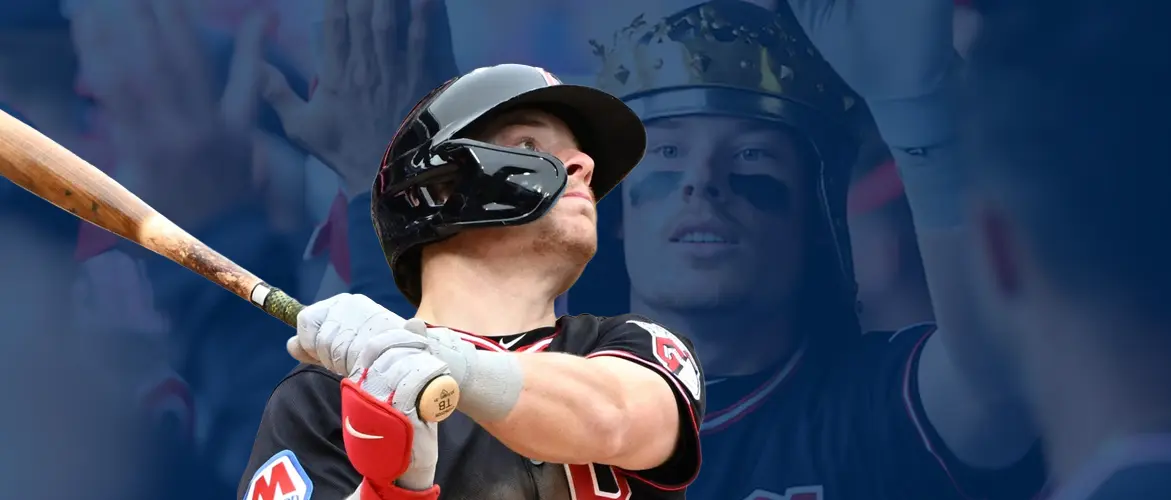
Travis Bazzana produced a swing Sunday in Philadelphia, which if replicated often enough, will make him a superstar.
In the top of the eighth inning, Phillies right-hander Jonathan Bowlan tossed a 97-mph fastball tracking in just off the plate – a difficult pitch to pull.
As the pitch raced to the inside corner, Bazzana’s swing beat it there. The left-handed hitter stepped into the bucket with his lead leg, creating space to allow his hands to work. The result was a missile of a home run to his pull side, which ended up in the second deck at Citizens Bank Park.
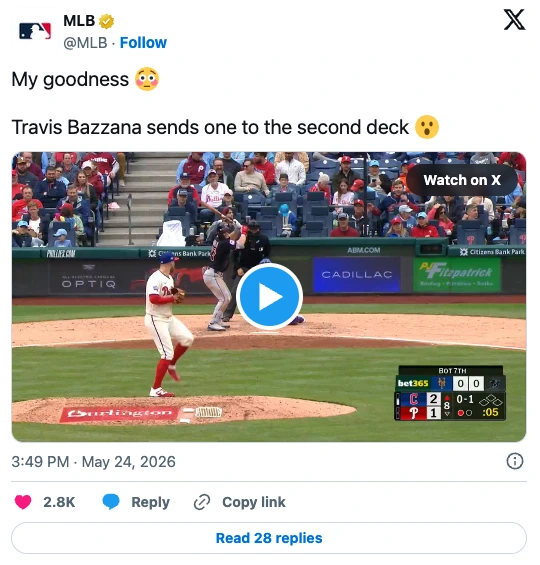
The ball left his bat at 105.3 mph, the second-best EV mark he has posted in his young major league career.
After struggling to pull the ball in the air in his initial exposure to major league pitching, the blast marked his second homer to his pull side last week. (He also pulled a home run at Comerica Park on Tuesday, against Tigers right-hander Keider Montero.)
The Guardians drafted Bazzana first overall in 2024’s loaded first round in part because of his floor. His batting eye and contact ability make it incredibly difficult for him to fail provided he enjoys good health. But Bazzana remains interested in raising his ceiling, even as a polished college player.
Even though he has reached the major leagues, he does not believe he is done improving. And he knows exactly what he needs to do to become a star.
“My ceiling is primarily about my ball flight,” Bazzana explained. “I am going to square up the ball. I’m going to make good swing decisions. So, can I put the ball in the seats to the right-field side? That is going to be my ceiling. Can I make my ‘A swing’ (often) and have good ball flight? That is what got me drafted where I was as a second baseman – how consistently I did that during my junior year. And we worked intentionally on that to be in that spot. Getting there more consistently with ball flight is where I reach my ceiling.”
Bazzana is not a towering physical specimen like the A’s Nick Kurtz, who went fourth overall in Bazzana’s draft class. While he is a quality athlete, he must get the most out of a relatively modest frame.
In some ways, he is not so different from his undersized superstar teammate Jose Ramírez, who always enjoyed strong contact skills, and learned to optimize ball flight.
To access that ceiling, he possesses a superpower few possess: self-awareness.
He identifies and accepts areas in which he needs to grow and improve, and attacks them. He obsesses over the Hows and Whys of the craft. His baseball makeup is even rare among the major leaguers Driveline trainers work with. What does that look like? Driveline hitting director Tanner Stokey has a favorite anecdote.
Entering the summer of 2022, Stokey received a call from Bazzana’s then-agent, David O’Hagan, of Excel Sports Management.
Coming off a freshman All-American season at Oregon State, Bazzana was invited to play in the Cape Cod League, the illustrious wood-bat circuit where college stars attempt to raise their prospect status. Every player accepts that golden ticket. Former Driveline hitting trainer Andrew Aydt couldn’t recall anyone who had ever turned it down.
Well, there’s a first time for everything. There’s Travis Bazzana.
“(O’Hagan) called me toward the end of his freshman year at Oregon State,” Stokey said. “The first thing he told me was, ‘You’re going to want to hire this kid someday.’ I was like, ‘What the hell are you talking about?’”
O’Hagan then explained that Bazzana wanted to train at Driveline instead of playing at the Cape.
Excuse me, Stokey thought.
“At the time, I thought it was a little crazy not going to play in the Cape — if there’s a summer league to play in, that’s the one,” Stokey said. “But Trav is self-aware enough to know that he was likely going to be a first-round pick (one day), if not very close to it, and he wanted to find ways to become as valuable and productive as he possibly could.”
Bazzana became aware of Driveline in his native Australia because Baseball Australia had a relationship with our company. Bazzana got his hands on bat-speed trainers from former MLB player Glenn Williams, now CEO of Baseball Australia, and followed a Driveline bat-speed protocol.
“I wore them out,” Bazzana said of the bat-speed trainers.
As a young amateur, Bazzana played with the Ku-Ring-Gai Stealers club on Sydney’s North Shore. While he did not have access to bat- and ball-tracking technology then, he had a desire for a data-based feedback loop to guide his progress. To monitor bat-speed progress, Bazzana hit off a tee in the spartan Ku-Ring-Gai Stealers cages while his father tracked ball speed via a radar app on his smartphone.
He was Driveline-like before he ever stepped into our Kent, Wash., facility.
“I think it just stems from the fact that I always wanted to know the ‘Why’ behind things,” Bazzana said. “That was important to me. So, if there’s a number that gives me objective feedback or reasoning, I always look for that, and look for the edge.”
Bazzana developed a belief that he still holds: playing in games raises a player’s floor, but training skills raise a player’s ceiling.
“When you’re playing every day, it’s very hard to make the changes necessary to change your ceiling,” Bazzana said. “Changing your ceiling comes from changing power outputs, and larger swing adjustments. There are approach adjustments that change your ceiling, too, which can happen from game assessment, and playing in games, and realizing, ‘Oh, I just need to change where I’m looking for pitches.’
“But I think quality offseason training is where people change how good they can be, or, how great they can be, especially at a young age.”
That foundational belief was forged in Australia, but he still believed it when he weighed what to do with his summer before his sophomore year.
“I remember talking to my hitting coach at Oregon State, Ryan Gipson, in an airport during my freshman year,” Bazzana recalled. “I had this opportunity to play in the Cape. I had two summers before I was draft-eligible, so it was like, ‘Do I really want to go possibly play twice?’ I felt like I had room for improvement and an opportunity to take advantage of that time. I brought up what I thought I could work on, and what the training would look like. (Oregon State) trusted what I was planning to do because I had conviction.”
So, instead of doing what every other freshman All-American had done when handed a ticket to the Cape, Bazzana went to Driveline.
For 10 weeks, and six days a week that summer, he worked with Stokey, Aydt — now with the Nationals — and others.
“We spent that offseason wanting to increase his bat speed and improve his ball flight to the pull side of the field,” Stokey said. “But what we really ended up doing on the front end was cleaning up his bat path, and his posture, with all the biomechanics data.”
When he returned to Corvallis as a sophomore, his production jumped across the board.
His home run total nearly doubled from 6 to 11. His OPS increased from .903 to 1.222, with his on-base mark jumping to .500.
The posture changes helped not just his swing characteristics but his selectivity at the plate, which is now a signature trait. He owns an elite 13% walk rate in the majors.
“The biggest changes were setup, a postural (issue), that affected my path,” Bazzana said. “So, my speeds rapidly jumped once I could do that, because, I was actually using the strength I had, the power I had. It also helped my swing decisions because I was taller… I felt like I could see (pitches) better early on, which meant I did not chase as much in the dirt. That’s when my swing decisions started to really evolve as well. There were a lot of things that came with that summer. It was just good, quality work, and it put me on the path to being a better offensive player.”
In his first summer with Driveline, he created a better foundation for his swing.
And after his second summer he began to learn how to more often access his “A” swing.
The 5-foot-11, 199-pound Bazzana had known optimized ball flight was important for an undersized player even before it was widely quantified.
He picked up on the cheat code as a youth in Australia well before public data was easily accessible, before the insight became popularized.
“I used to say to people when I was in high school in Australia that there’s a reason why Jose Altuve can hit 25 home runs, and there’s a reason why Alex Bregman can hit 20, 25, whatever, 30 home runs. Mookie Betts, too,” Bazzana said. “I used to bring up all these guys with frames kind of in that 5’8” to 5’11” range that hit 20 to 30 home runs.
“You can’t tell me, ‘Oh, you won’t hit for power because that’s for the big guys.’ People do it, and so I was big on that. I was like, ‘OK, well, power output, and where do they hit the ball?’ I had a full awareness of that in high school. People probably were like, ‘What is this guy talking about back then?’… But I didn’t learn how to do it immediately because my swing was so ingrained.”
But he knew what he needed to do, and with help from Driveline he mapped out an actionable plan.
“It’s crazy, the self-awareness,” Stokey said.
After his second summer training at Driveline, his ball flight improved dramatically. It’s what allowed him to lead the PAC-12 with 28 home runs, a power surge that vaulted him to first-overall-pick status in a draft loaded with bigger, stronger athletes.
He knows repeating that at the highest level is key to being a major-league star.
Bazzana’s Air Pull% was 11.9% entering play May 22.
It’s already improved to 14.6% as of May 25.
The MLB average is 16.9%.
Bazzana’s goal is to be in the upper 20 percent range – an elite range.
Stokey believes it will improve. After all, it’s still so early. We are in the first pages of his first MLB chapter.
“Some of it is pitch selection. Some of it is being willing to take his chance in hitter counts,” Stokey said. “Some of it is getting more pitches over the heart of the plate and being in two-strike counts less often.”
Stokey does not think Bazzana is done raising his ceiling in other areas either.
Bazzana is posting modest bat speed (69.4 mph) and exit velocity marks (88.8 mph) early in his MLB career. Stokey knows he holds the capacity for much more. He’s seen it in action. He’s measured it in our Kent, Wash., batting cages. And of his first 65 MLB swings, 14 have been 73 mph or faster- or greater than the MLB average for bat speed.
“He hasn’t quite gotten that ‘A-plus’ swing off very often, at least not as much as he has in the past, or, what he’s capable of doing,” Stokey said. “That’s the thing that’s going to open up the slug for him.”
For Stokey, a bet on Bazzana building more capacity and raising his ceiling even at the highest level is likely to happen – it almost seems inevitable to those that know him best – and boils down to this: his makeup.
“He’s one of the most competitive people I’ve met in my entire life,” Stokey said. “He’s really driven to be great. He’s truly obsessed with the process and the information. He wants to know exactly what makes him good, and why. He also wants to understand what he struggles with, why, and how to improve. A lot of times you can run into a really intelligent, high-level thinker as a hitter, and it could turn into a problem quickly, where they start to get overloaded with information and really spiral out of control. But he’s one of the best hitters I’ve ever interacted with at being able to take a ton of information and simplify it down to the most actionable points.”
Stokey remains in daily contact with Bazzana and former Driveline trainer, and Guardians assistant director of hitting, Connor Watson. They have a group text thread where they share thoughts regularly.
“At the end of the day, he’s just a relentless, obsessive competitor, obsessive with developing and getting better,” Stokey said. “He wants to know every single piece of information to understand the ‘Why’.”
It’s a superpower few possess, one that allows Bazzana to keep raising his ceiling, to have the baseball world keep rethinking what is possible for an undersized slugger from the other side of the world.
Comment section