Pitchers are going low – and for good reason. But it’s not for everyone.
Some of baseball’s skill-enhancing breakthroughs are well known.
Velocity-building programs have proliferated across professional and amateur baseball over the past decade. Pitch design is another field creating significant performance gains, which also spread rapidly across the sport. Driveline Baseball is a pioneer and innovator in these disciplines.
Throwing faster, creating pitches with optimized movement, improves performance outcomes. Their benefits have been well publicized and thoroughly studied.
But there are other, more subtle trends in the pitch-tracking era, including one that is going a bit under the radar: pitchers are going low, and a little lower every year.
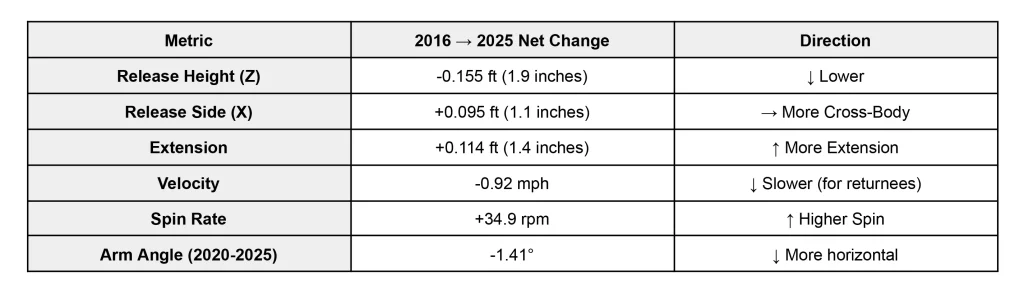
I examined the last decade of MLB pitch data (2016-25), studying release point changes of individual pitchers, year over year, an apples-to-apples analysis.
What I found is that in eight of the last 10 seasons pitchers have lowered their arm slots.
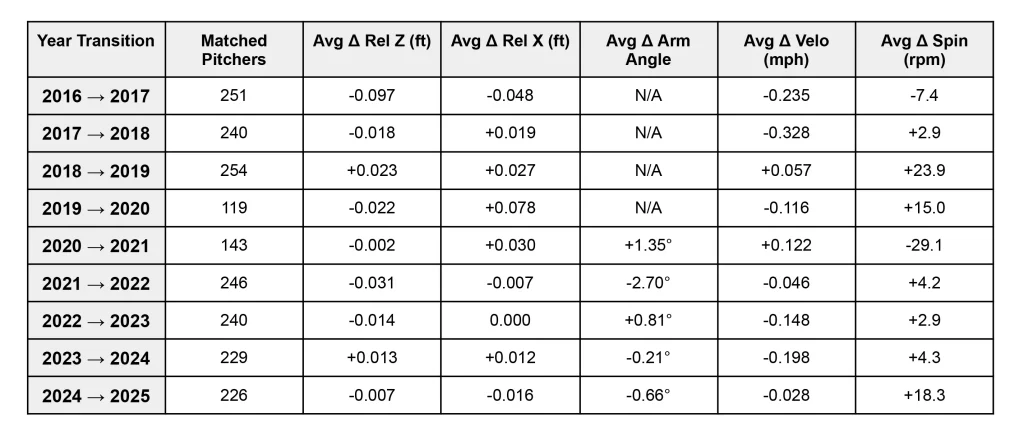
In total, the MLB pitchers studied (minimum 500 pitches in a season) are releasing pitches two inches lower than 2016. Arm angle is also down 1.41 degrees since 2020, when the measurement first became publicly available.
While it can be difficult to isolate trends to one variable, there are plenty of pitchers who have had the intent to change, to drop down. Pitchers, like Garrett Crochet, who lowered his arm angle during his breakout 2024 season, and again during his excellent follow-up last season, to great success.
Zack Wheeler is the gold standard of this.
He dropped his arm slot in two consecutive seasons, 2021-2023, dropping from 38.9 degrees to 31.8 degrees over that two-year span and produced the top fastball run value (+23.7) in the dataset.
So, why are many pro pitchers doing this?
What benefits occur? What are the trade-offs?
And what pitchers – whether in the pro or amateur game – stand to benefit by going low?
Let’s explore, shall we?
Seattle Mariners right-handed pitcher Bryan Woo is a prime example of what is possible with an optimized lower release.
Despite hitters knowing what is coming with Woo — he throws a four-seamer at about a 50% rate for his career – batters have struggled mightily with the pitch. His demon of a four-seamer enjoyed a +21 run value last year, tied for second in the majors among four-seamers.
On the surface, the pitch’s success is a head scratcher if you are not familiar with the offering.
After all, Woo throws with just a tick better than league-average velocity for a right-hander. He generates only average induced vertical break, too.
What makes his fastball unusually effective is its combination of his lower arm slot, which gives him one of the flattest approach angles in the game – the steepness of a pitch as it arrives to the plate – combined with his pristine command of the pitch.
The sum of those characteristics create an incredibly deceptive, gravity-fighting pitch that batters struggle to square. MLB hitters whiffed a 37% rate on the pitch last season – even when they know it is coming.
Driveline Baseball pitcher trainer Rollin Payton Tyler said lowering a pitcher’s arm slot can be a meaningful way for pitchers to create a “riding” fastball effect without producing above-average IVB.
“Bryan Woo, for example. His VAA on average is like four degrees (extremely “flat”),” Tyler said. “You’re going to be able to get guys to swing under your fastball.”
Tyler notes another example of this fastball type is Joe Ryan, who has trained at Driveline.
Ryan also enjoys plenty of swing and miss on a fastball featuring below-average velocity for a right-handed pitcher.
There are trade-offs with every change, however, and one common one with lowering slot is it reduces velocity.
Pitchers who lowered their arm slot lost, on average, 0.15 mph season over season.
If lowering an arm dramatically reduces velocity it might not be worth the trade-off.
“Velocity is king,” Tyler said. “Then we start thinking about shapes.”

This is where art meets science when determining what to do with arm path.
In our video meeting, Tyler shared a biomechanics report of an amateur pitcher training with us. Tyler directs my attention to the pitcher’s posture metrics, which includes measurements and line charts of different components of the athlete’s throwing motion.
“‘Torso side bend at foot plant,’ that’s basically how far I’m tilted this way,” said Tyler of this particular measure, tilting his right shoulder toward the third-base side at release to mimic a left-handed thrower. “We generally want to be as high up on the Y axis. … The more side bend we create, the more velocity we create.”
But more side bend also corresponds with raising a release point.
Tyler notes this athlete ranks in the 52nd percentile of side bend at foot plant. Our software calculates it’s costing him 0.04 mph. Is it worth altering his release point?
“If we move him all the way to the right (on the Y axis) is it a full (mph)? Is it only four-tenths?” Tyler said. “It’s kind of individually specific, but these are the variables that we try and talk and think about when we make decisions in regard to adjusting arm angles.”
Another consideration is how lowering an arm slot can affect movement profiles.
Tyler notes how as a lefty, if he lowers his slot the direction of finger placement changes from nearer 12 o’clock, with a more over-the-top release, to nearer 9 o’clock. Such a change would have a dramatic effect on movement profiles.
“It all has to be taken into consideration,” Tyler said.
One of the most effective lower-slot movement profiles is, again, the high-efficiency fastball with a flat approach angle, the signature trait of Woo and Ryan.
But that requires a pitcher to have enough radial deviation, or wrist mobility, to create the right seam orientation at throwing release. In other words, more active spin – efficient spin. True backspin.
Ryan’s four-seamer features 97% active spin from that slot last season. That’s almost perfect spin efficiency. Woo’s active spin also above-average at 91%, rare from such a slot.
“If I can lower your slot and radial deviate your hand when you throw, and maintain your IVB, then we’re probably looking at creating something close to an outlier fastball,” Tyler said.
Not everyone has such mobility.
However, one way to hack the lower slot for a pitcher unable to maintain high active spin is to throw a cutter from that position. “You can have that more aggressive VAA and still generate some lift,” Tyler said of throwing a cutter from such a slot. A high-ride cutter is effective on its own, Payton noted, but like a four-seamer that can maintain its efficient spin from a lower slot, a cutter can enjoy similar benefits.
There are additional benefits of lowering slot beyond adding deception, the riding effect of a fastball.
While velocity generally declines with slot angle, pitchers who lowered their slot over the last decade gained spin.
Consider in the two most recent seasons studied, 2024 and 2025, our sample of 226 MLB pitchers gained, on average, 18.3 rpm on their four-seam fastball. This was despite velocity loss.
Lowering slot doesn’t guarantee success but when it does work, it can be significant.
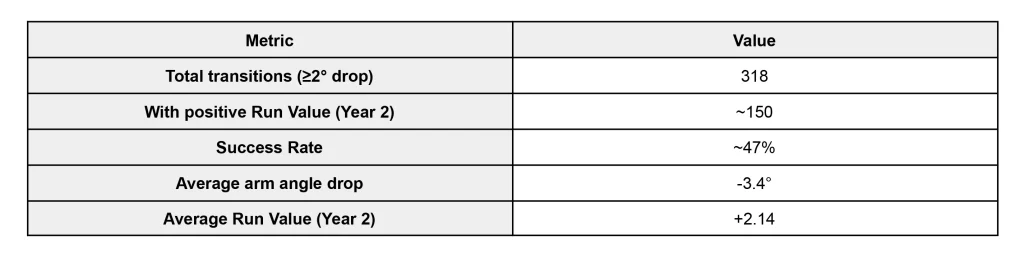
Among pitchers who dropped their arm slot at least 2 degrees season over season since 2016 – and threw at least 500 pitches in both seasons – they enjoyed a +2.14 run overall.
There could be health-related benefits when lowering arm angle and slot.
A study authored by South Korean and Chinese researchers Maolin Dong, Ming Li, Qingling Qu, and Youngsuk Kim published a fascinating finding. They found elbow varus torque increased by 4.23 newton meters for every 10 degrees a pitcher’s arm angle raised. That is significant as there are about 100 newton meters of force in a throwing motion. A four percent reduction in stress is not nothing.
“A lot of people were mentioning this study … and it kind of coincided with a lot of guys lowering their arm angles,” Tyler noted.
But expanding the sample all the way back to 2016 shows that the 339 pitchers who raised their slots by at least one degree threw 108 more pitches on average than the previous season. However, the correlation was weak (r =0.12) meaning that arm slot only explained 1.4% of the variation. There is also certainly selection bias involved. Perhaps teams were allotting more work to what are perceived to be arms with “cleaner” over-the-top mechanics, for example.
Taking all these trade-offs together, what archetypes of pitchers should explore this change? Who ought to consider going lower?
Tyler said the starting point is considering what a pitcher can do well. Then we build from there.
“It’s a spectrum,” Tyler said. “If you’re a guy who can radial deviate a lot, and maybe you don’t get a lot of IVB as it is … drop down, and radial deviate, and now you’re VAA has gone from like 5 ½ (degrees) to like 4.2 or something. You lost IVB, but your fastball shape got significantly better.
“But if the risk-reward is like, ‘Hey, I’m going to lose two miles an hour.’ Well, we don’t want to do that. There are so many variables that go into it. It could be as simple as like, ‘Hey dude, drop down a little bit, how’s that feel?’ And they go ‘Man, that’s nice,’ and they don’t lose any velocity. Or. they go ‘That sucks. I hated that.’ And you’re like, ‘Alright, ‘cool.’ It just took us six throws, and we just know that this isn’t it.”
Dropping down is not for everyone. There is an art, science, and spectrum to it. Paul Skenes dropped his arm slot last spring but reverted back to his 2024 slot in the regular season. It’s not for everyone. But for some arms it can unlock a new level of performance.
Comment section