Powering up: George Gibbs is a classic Driveline success story, now he’s ready for what’s next
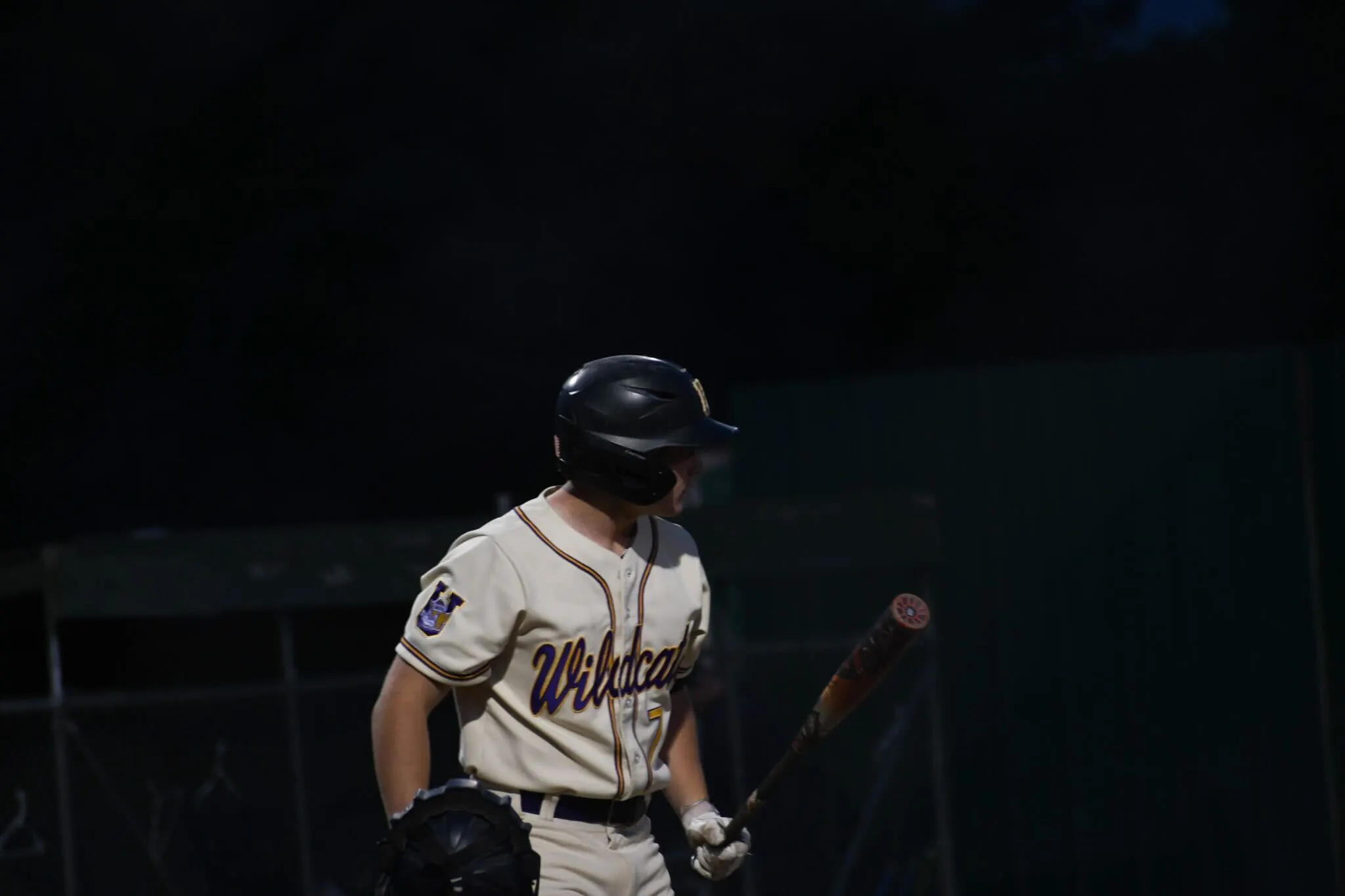
There are countless 11-year-olds glued to YouTube where an endless stream of gaming- and entertainment-related content is uploaded daily to the platform.
Fewer ‘tweens are watching Driveline Baseball videos.
But George Gibbs was watching our YouTube channel as a middle schooler. The habit demonstrated a precocious level of interest in self-improvement, serving him well as he enters his senior season at Ukiah High (Ukiah, Calif.).
“I remember I’d watch hitting videos on YouTube with like Deven Morgan, and (former Driveline hitting guru) Jason Ochart,” Gibbs said. “They would post some hitting drills, and I would watch them, and study them… I would see the graphs of how hitting the ball hard is when you’re going to have the highest batting average, highest OPS…
“Just nerd-ing out about baseball.”
His goal today is to play at the college level. Gibbs is an uncommitted outfielder/infielder.
Gibbs was perhaps predisposed to the Driveline method as he had always tried to hit the ball with authority.
“There’s pictures of me playing T-ball. I had a huge leg kick and I was just gritting my teeth,” Gibbs said.
In watching the Driveline videos, and hearing about the first-principles approach of our staff, he learned how hitting the ball hard could be trained and improved, that it was not only an innate skill.
Understanding this helped spark a self-improvement journey.
His parents encouraged his baseball interest and curiosity. He bought a bat speed training set, and as he became more serious as a player – he made the varsity baseball team as a freshman – he made his first trip to Driveline’s Seattle campus as a sophomore in the summer of 2024.
It was in Seattle where he began to work with Driveline trainer Jacob Hirsh.
After his first assessment as a sophomore, it was clear he had work to do.
“A guy with 60 mile-an-hour bat speed is going to have a very hard time turning heads,” Hirsh said.
Gibbs had to make major strides, and he did thanks to help from Driveline and what Hirsh described as rare work ethic.
“There’s a big group of athletes that say they want to get better and not all of them mean it. George truly meant it,” Hirsh said. “That’s been reflected in the improvements that he’s made as an athlete, and as a hitter overall.”
Gibbs had seen the criticism of bat-speed training online – often someone selectively showing extreme training drills without context – but he learned more of the underlying principles during his time in Seattle.
“I started to learn ‘Hey, you don’t necessarily need to swing 100% in game,’” Gibbs said. “The argument is always ‘(Bat speed training) is not productive because you’re just going to swing out of your shoes in a game.’ But I started realizing that if you build up your power floor then you can get in a game, and you don’t have to swing (with max effort). You can put balls in the gap, hit doubles, home runs, and triples.”
He learned it was about building a more powerful engine. He understood he needed that if he was going to play Division I college baseball. He returned home with a strength- and bat-speed training program.
Three days a week he engaged in bat-speed training drills.
He liked the “Kershaw” drill…
He utilized the “hook ‘em,” and the step backs, too:
“They’re definitely my go-to’s, because they really help me get my hips firing, and just moving quick,” Gibbs said. “Even on game days, I’ll do those drills before I hit with my game bat in the cages to warm up. It just really helps my hips fire and just feel great… Those are the three main drills, and I’ve always had those ingrained in my program. I’ve always liked them and had fun hitting with them…”
While he’s made subsequent trips back to Seattle to be assessed, most of his work with Hirsh and Driveline has been done remotely sharing videos and messages, and encouragement, through the TRAQ app.
“You have to commit to it, you have to buy in, and it did come with a lot of me pushing him early on like, ‘Dude, you’re so close to 70 miles an hour. You’re so close. Keep going, keep going,’” Hirsh recalled. “And then eventually he cracks that 70 mph mark and it’s like, nice job. You just broke through!”
He also gained weight and strength through a Driveline, individualized strength plan, a key component in gaining more ability to damage.
When he first arrived in Seattle, he weighed 174 pounds. Today his 5-foot-10 ranges between 190 and 195 pounds.
“I’ve gotten a lot stronger,” Gibbs said.
There was one other process adopted by Gibbs that ingrained healthy development habits: the benefits of data-based feedback loops.
Gibbs bought a Blast Motion swing analyzer and employs the tech regularly to monitor progress in terms of his bat path and swing speed. There’s also a HitTrax at his high school’s batting cage.
The data streams he studied also helped him gain conviction in his training regimen. It helped push him to become even better.
“I think the Blast is the most important. It holds yourself more accountable,” Gibbs said. “I think a lot of people just go hit in the cage, they take some swings, they tell themselves they’re feeling good. But they never really have numbers, or see ball flights, or see how hard they’re hitting balls or anything. They kind of just tell themselves that. And that can be good, but you never really know if you make much progress.”
The results have followed and been undeniable.
As a sophomore he hit .290 with only two extra base hits, a pair of doubles.
But last season as a junior, he hit .360 with two home runs, eight doubles, and a triple – and was at the top of the slugging leaderboard.
This was supported by underlying gains.
During his first assessment at Driveline, his bat speed was in the low-60s mph. He topped out with a 94 mph exit velocity in testing.
During his most recent assessment in November, his bat speed had spiked to 74-75 mph.
“When he first came in, his average bat speed was around 60 miles an hour during his first assessment, which is below the high school average,” Hirsh said. “Now, his average bat speed pushed up to 73 miles an hour. A 13-mph increase in bat speed over the past two years is cool to see.”
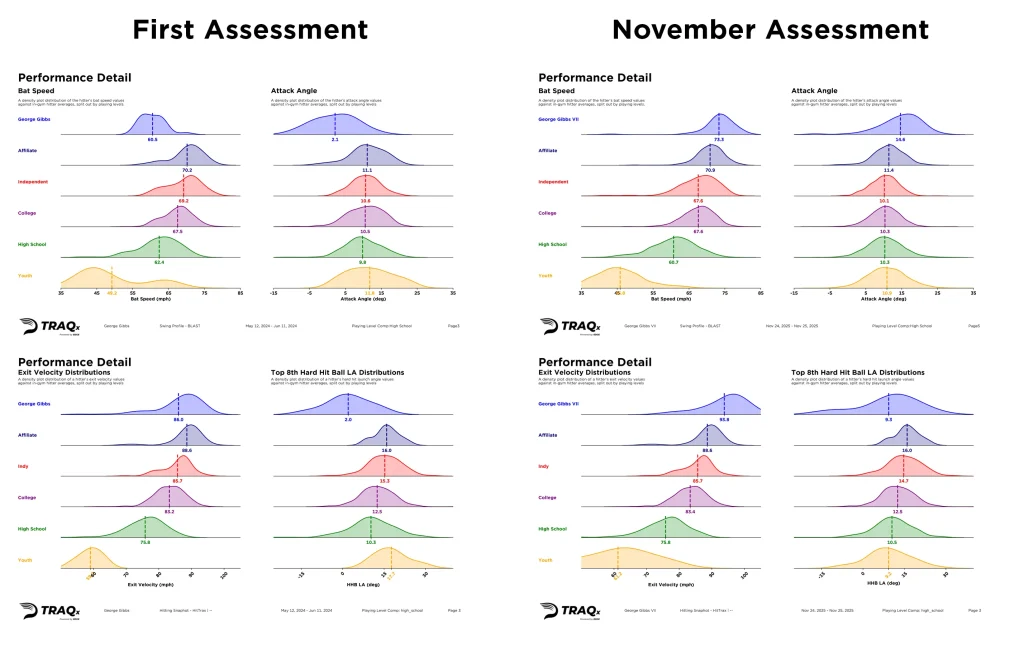
His exit velocity spiked to a personal best 104 mph.
Lots of hard work ahead but very happy to reach 104 Exit Velocity in my retest @DrivelineBB last week. pic.twitter.com/4hfm8kD3wM
— George Gibbs (@gibbs_george26) November 30, 2025
“I hit 104 in the Launch Pad, which was really cool,” Gibbs said.
Hirsh said such an improvement is not an outlier story at Driveline. It can happen. But it requires an investment in time, an openness to new approaches, and honest communication that Gibbs displayed.
“I think really challenging yourself in your training environment is the best way to gain progress,” Gibbs said, “and you can do that at Driveline.”
Comment section