
Posts Tagged research

How Research Plays a Role at Driveline Baseball

We pride ourselves on trying to keep up with all the latest research in biomechanics and kinesiology as it relates to baseball athletes. Most traditional coaches out there have little to no knowledge of published research on pitching biomechanics, but at Driveline Baseball we think it’s important to stay on top of both the research being done in the labs and the work being put out in the trenches of the strength and conditioning community.

Additionally, we’re currently planning research studies for Fall 2011 of our own, including more tests of our Biomechanical Video Analysis services. Few coaches out there can say that they are using a biomechanical lab to complete their own research on pitching mechanics.

Here’s a short list of selected research papers we’ve read, digested, and have helped form our theories on how we coach and train pitchers.

  • Biomechanics of Pitching (Zhen, Fleisig, et al – from the Biomedical Engineering Principles in Sports textbook)
  • Baseball Throwing Mechanics as they Relate to Pathology and Performance (Whiteley, 2007)
  • Biomechanics of Pitching with Emphasis upon Shoulder Kinematics (Dillman et al, 1993)
  • Biomechanics of the Shoulder in Youth Baseball Pitchers (Sabick et al, 2005)
  • Correlation of Throwing Mechanics With Elbow Valgus Load in Adult Baseball Pitchers (Aguinaldo et al, 2009)
  • Humeral Torque in Professional Baseball Pitchers (Sabick et al, 2004)
  • Kinetic Comparison Among the Fastball, Curveball, Change-up, and Slider in Collegiate Baseball Pitchers (Fleisig et al, 2006)
  • Pitching Biomechanics as a Pitcher Approaches Muscular Fatigue During a Simulated Baseball Game (Escamilla et al, 2007)
  • Relationship Between Throwing Mechanics and Elbow Valgus in Professional Baseball Pitchers (Sabick et al, 2002)
  • Valgus Torque in Youth Baseball Pitchers: A Biomechanical Study (Sabick et al, 2004)
  • Coaching Baseball Pitchers (Marshall, 2009)

See more over at our Research Studies page.


, ,

No Comments

Smart Readership of Driveline Baseball

While I was working on the Velocity Development Program series of posts, I noticed this trend of clicks on our site:

Our Readership is Smart!

These are this morning’s outbound clicks. As you can see, the majority of them go to abstracts of studies that I’ve referenced on the site in various posts and pages. This is very common – our readership is very interested in doing their own research and learning about the biomechanics of pitching. I can’t say how great this makes me feel – the blog’s intention is not only to promote the training methods and business of Driveline Baseball, but to help educate people about pitching/throwing/hitting and providing links to resources out there.

I’m currently reading Biomechanical Analysis of Forearm Pronation and Its Relationship to Ball Movement for the Two-Seam and Four-Seam Fastball Pitches (abstract link), and it’s very interesting. The principle author/investigator has many other intriguing studies that I’ll be looking into, and she has many open studies looking for participants.

To sum it all up: Thanks for being so engaged. It’s good to know that my thousands of words on studies, research, and other esoteric stuff don’t go to waste.

, , ,

No Comments

Strasburg, The Inverted W, and Pitching Mechanics

EDIT: Welcome Grantland visitors! Be sure to read the follow-up on Strasburg’s Timing Flaw that Tom Verducci wrote about in Sports Illustrated.

A friend of mine told me that my old blog (Driveline Mechanics) was mentioned on a recent Fangraphs audio podcast, and perhaps in a derisive way. I’m not big on podcasts (I prefer reading), but checked it out as I really enjoy the Fangraphs content and saw that a former writer that I employed (Matt Klaasen – “devilfingers”) talked a little bit about this with Dave Cameron.

I checked it out and listened to the podcast to hear what they had to say about pitching mechanics, and most of it was fairly decent. Bryan Smith made a great point when he wondered about the fast velocity gain that Strasburg saw from HS to College (went from touching 90 at best to consistently throwing 97+). Much of it can be explained due to Strasburg’s attitude being generally terrible in HS and seeing the light when he went to San Diego State, but it’s definitely a red flag when you see rapid velocity improvement in an already mature pitcher.

Dave Cameron then said:

…the whole theory about the Inverted W… that Strasburg was labeled as one of those guys who uses that kind of arm action… the theory that those guys break down more often… there’s no actual evidence for this and there’s no proof… most people who study pitching mechanics disagree with the theory.

First, let’s talk about what the Inverted W is. Paul Nyman of SETPRO first coined this term for the arm action that generally produces the elbows being above the shoulder line in a position of shoulder horizontal abduction. A good example of this is Mark Prior’s arm action:

Mark Prior's Inverted W

Mark Prior's "Inverted W"

Next, let’s see if Strasburg’s arm action could be classified as an “Inverted W:”

Stephen Strasburg

Stephen Strasburg

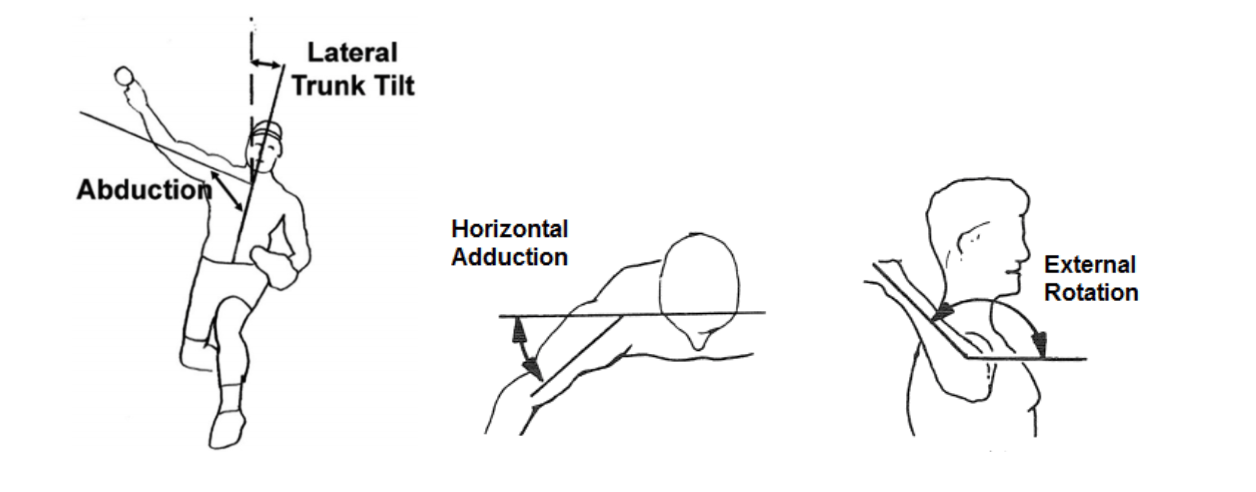
Perhaps it could be, but I mostly see a large amount of shoulder horizontal abduction (pinching the shoulder blades together) rather than true hyperabduction. I talked about this in a previous blog post of mine that discussed elbow injuries, and if you haven’t read it, it’s a good backstory to this blog post.

Let’s move on to Dave’s comments, specifically this portion:

…there’s no actual evidence for this and there’s no proof… most people who study pitching mechanics disagree with the theory.

Dave is saying that there’s no proof that the so-called Inverted W can lead to any type of injury. Well, that’s not entirely true. In a previous post on this blog, I detailed how bone is sensitive to loading rate. Sabick et al. also determined in Humeral Torque of Professional Baseball Pitchers that “pitchers who elbows were more extended at stride foot contact tended to have lower peak humeral torques.” You can see above that Strasburg’s glove side foot is nearly planted yet his elbow is fairly flexed; this is common in pitchers who exhibit the “Inverted W”.

Additionally, Werner et al. noted in Relationship between throwing mechanics and elbow valgus in professional baseball pitchers that peak shoulder horizontal adduction angular velocity was positively correlated with increased rates of elbow valgus stress when studying professional pitchers at spring training games. We know for a fact that the ulnar collateral ligament (UCL) is taxed when elbow valgus stress increases; the anterior band of the UCL is the primary stabilizer in the elbow as the forearm lags behind the elbow. (Source: Medscape) As I talked about in my previous article about elbow injuries, Stephen Strasburg has high rates of shoulder horizontal abduction which leads to faster shoulder horizontal adduction angular velocity. This is common in pitchers who have the “Inverted W” in their arm action.

Delving further into pitching mechanics, we can look at the paper Aguinaldo et al. wrote titled Correlation of Throwing Mechanics With Elbow Valgus Load in Adult Baseball Pitchers and discuss how the “Inverted W” can cause a more extended elbow at release which is correlated with elbow valgus torque.

While I strongly dislike people who point at pitchers with the “Inverted W” and say that they’re on a fast track to Tommy John surgery, what they are saying is not without merit. The particular flaw that the “Inverted W” depicts might very well positively correlate with increased stress on the arm based on all the research that has been done on pitching mechanics.

As for “most people who study pitching mechanics disagree with the theory,” who are these people? You won’t find a condemnation from the American Sports Medicine Institute (ASMI) about this; you can check their message boards and read what they have to say about it. The only thing that Dr. Fleisig has said about Stephen Strasburg is: “What makes [Strasburg] good is that he doesn’t have a weak link in his chain of events or a mistimed motion.” In this, Dr. Fleisig is referring to his delivery with regards to efficiency to produce maximum velocity and not necessarily injury potential (since we do not know exactly what mechanical factors cause UCL failure or shoulder damage). I can’t find too many people who publish research papers that will state outright that the “Inverted W” is not any worse for the pitching arm than a lack of it in the delivery.

Dave talked about how people flooded his blogs (USS Mariner and Fangraphs) saying that Strasburg deserved this or that it was easily predictable. This was a major reason why I stopped writing at my SB Nation blog: Driveline Mechanics. Far too many people took my observations and writings as gospel or misinterpreted it as a concrete example of what not to do or what should be done in the pitching delivery. People flooded various blogs saying that such and such mechanical flaw leads to injury, when that’s absolutely not true. I’m building a motion capture laboratory in Seattle with the hopes of studying this myself and publishing the data for all to view as an open source project (unlike every other motion capture lab in the country). And when it’s nearly complete, Graham Macaree of Lookout Landing fame (Biomechanics and You is an excellent piece by him) has a standing invitation to come critique it and hopefully give me his ideas on how to improve it.

Let’s work together and find the answers – if there are any. Remember – I’m hiring, and I need your help.

, , ,

6 Comments

Mechanics: The Effects of Loading Rate

Just wanted to drop a short post in about loading rate as it relates to the humerus and possibly the connective tissue in the pitching arm during the throwing motion.

In Humeral Torque in Professional Baseball Pitchers, Sabick et al. concluded that “pitchers who elbows were more extended at stride foot contact tended to have lower peak humeral torques.”

So, in theory, an extended elbow at foot contact but prior to the maximum external rotation would decrease stress on the humerus. Remember that in Correlation of Throwing Mechanics With Elbow Valgus Load in Adult Baseball Pitchers by Aguinaldo et al. that increased elbow flexion was closely related to reducing valgus torque, so an extended elbow throughout the motion is not necessarily ideal.

elbow_valgus_load

Also notable is the fact that bone is sensitive to loading rate and not just peak values of stress – therefore, the faster and harder the humerus (and the connective tissue) is loaded, the more danger there is with regard to injury.

Many people focus on the total load and stress on the bone or connective tissue as the failure point of the body’s working parts and pieces, and indeed many laboratory (in vitro)  studies simulate only this variable. As Sabick et al. pointed out in the aforementioned paper:

Simply comparing dynamic pitching biomechanics data to bone strength data from in vitro studies is actually over-simplifying the problem. Bone strength is sensitive to loading rate. Differences between loading rates in the laboratory and those occurring during pitching suggest that the data are not directly comparable. In addition, simple torsion is generally simulated in laboratory tests, but the situation is much more complicated in vivo. There are additional components of force and torque acting on thehumerus at the same time the humeral torque peaks. All of the force and moment components contribute to the state of stress in the bone,which changes as a function of time.

As I have often said, Humeral Torque in Professional Baseball Pitchers is one of the most influential papers written about pitching biomechanics as it relates to how we train and instruct our clients. For more information, check out our Pitching Program and see if it’s right for you. As you talk to coaches and other instructors, ask them about the this paper, or simply ask them what research papers and scientific principles have guided their methods.

, ,

8 Comments