

Posts Tagged biomechanics

Mechanics: The Effects of Loading Rate

Just wanted to drop a short post in about loading rate as it relates to the humerus and possibly the connective tissue in the pitching arm during the throwing motion.

In Humeral Torque in Professional Baseball Pitchers, Sabick et al. concluded that “pitchers who elbows were more extended at stride foot contact tended to have lower peak humeral torques.”

So, in theory, an extended elbow at foot contact but prior to the maximum external rotation would decrease stress on the humerus. Remember that in Correlation of Throwing Mechanics With Elbow Valgus Load in Adult Baseball Pitchers by Aguinaldo et al. that increased elbow flexion was closely related to reducing valgus torque, so an extended elbow throughout the motion is not necessarily ideal.

elbow_valgus_load

Also notable is the fact that bone is sensitive to loading rate and not just peak values of stress – therefore, the faster and harder the humerus (and the connective tissue) is loaded, the more danger there is with regard to injury.

Many people focus on the total load and stress on the bone or connective tissue as the failure point of the body’s working parts and pieces, and indeed many laboratory (in vitro)  studies simulate only this variable. As Sabick et al. pointed out in the aforementioned paper:

Simply comparing dynamic pitching biomechanics data to bone strength data from in vitro studies is actually over-simplifying the problem. Bone strength is sensitive to loading rate. Differences between loading rates in the laboratory and those occurring during pitching suggest that the data are not directly comparable. In addition, simple torsion is generally simulated in laboratory tests, but the situation is much more complicated in vivo. There are additional components of force and torque acting on thehumerus at the same time the humeral torque peaks. All of the force and moment components contribute to the state of stress in the bone,which changes as a function of time.

As I have often said, Humeral Torque in Professional Baseball Pitchers is one of the most influential papers written about pitching biomechanics as it relates to how we train and instruct our clients. For more information, check out our Pitching Program and see if it’s right for you. As you talk to coaches and other instructors, ask them about the this paper, or simply ask them what research papers and scientific principles have guided their methods.

, ,

5 Comments

My Recent Reading List

Over the past four years I’ve probably spent hundreds of hours reading research papers (full ones, not just abstracts), medical journals, and derivative materials to gain a better understanding of biomechanics, applied anatomy, and kinesiology as it relates to baseball and exercise science in general.

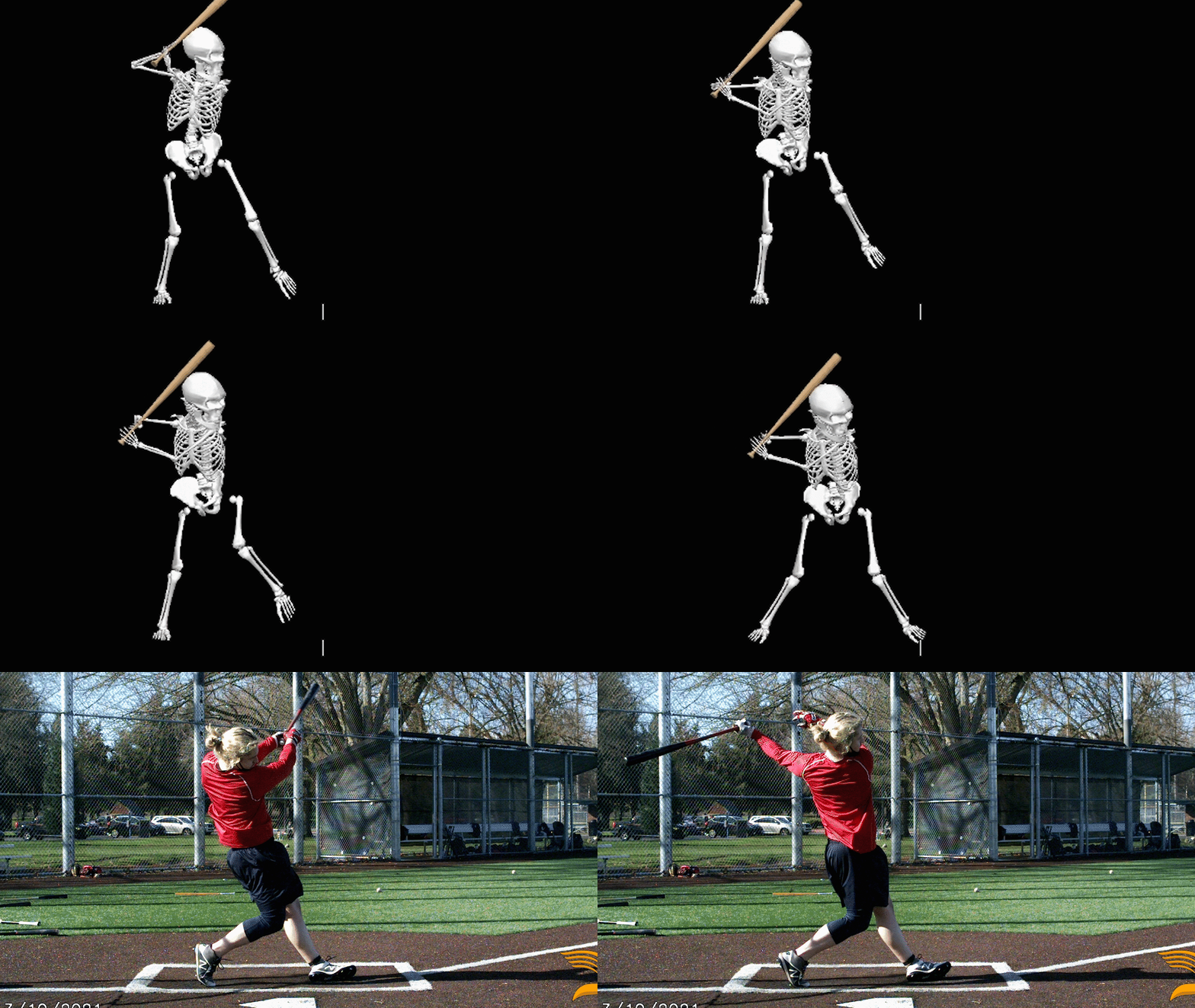
I’m currently doing a lot of research on how to convert 3d biomechanical models of pitchers (which we will be able to construct soon using software and four high-speed cameras that are being ordered for delivery in March) into usable data that includes things like joint loads and torques. This is a rather difficult task given the estimates that go into the methods, but what’s even more difficult to figure out are the methods themselves! Stuff like this isn’t exactly published for the layman and is typically only read by other professionals in academia, not coaches like myself.

Regardless, I continue on, seeking help on the ASMI message boards and asking multiple people in the industry and academia who are very gracious with their time.

Right now I’m focused on the following two papers and their derivative works (both are freely available):

Some of the research papers that I’ve loved in the past and continue to read over and over again are:

  • Humeral Torque in Professional Baseball Pitchers (Sabick et. al.)
  • Kinetic Comparison Among the Fastball, Curveball, Change-up, and Slider in Collegiate Baseball Pitchers (Fleisig et. al.)
  • Biomechanics of the Shoulder in Youth Baseball Pitchers (Sabick et. al.)
  • Correlation of Range of Motion and Glenohumeral Translation in Professional Baseball Pitchers (Borsa et. al.)

And one of the best papers that shapes the most of my training:

There are many others that I enjoy, but those are my favorite. Give them a shot if you’re got some time and inclination to read source material. A warning, though – it gets addicting to those with inquisitive minds!

, , , , ,

2 Comments