

Archive for January, 2012
Pitching Mechanics Myths: Chin to Target, Release Ball Closer to the Plate
While I’m working on my book – Fastball Training - there are a few blog posts I feel like I need to make because of myths that are constantly perpetuated about pitching mechanics that are pretty ridiculous and also easily disproved. Since I sublease space from North Seattle Batting Cages and the high school and Little League season is rapidly approaching, I get to hear a lot of outstanding “advice” from coaches who don’t understand the first thing about throwing mechanics. At this point in my career, I just find it humorous, when before it would actually bother me.
Anyway, here are two fun myths that I get to hear on a regular basis:
Take the Chin to the Target
This is a common mechanical cue that I think was first widely perpetuated by Tom House and the National Pitching Association. The NPA has come a long way with regards to different training philosophies (they still lag very far behind when it comes to weight training, but they do have weighted baseball programs now – which aren’t free, like ours is) and I’m not sure if they still believe in this, so I’m not blaming them for it. The point is that it’s still a widespread mechanical cue that coaches tell their clients all the time. Let’s get one thing straight: This might be the single best cue if you wanted to reduce fastball velocity in an athlete.
The idea that you should lead with the chin to the target to improve command and control of your pitches is ridiculous, just like most “simple” cues are. It’s a really tempting thing to want simple solutions to the complex machine that is the baseball pitcher, but if it was easy, we’d all be throwing 90+. Attempting to reduce the pitching delivery into stages of cues and checkpoints has done more to ruin youth pitchers than anything else in the last 10 years (except for maybe telling kids that throwing a baseball is an unnatural motion and will damage their arm).
When you consciously think about taking the chin to the target, you are killing rotational velocity around the pelvis and the shoulders. Research shows (and common sense verifies) that rotational velocity around the largest body parts are chiefly responsible for ball release velocity. The concept of squaring the shoulders up and reducing the effective distance the shoulders can rotate is a horrible cue.
If you’re a coach that teaches kids this, please stop. Furthermore, if you expect 12 year olds to throw 80% strikes, you’re the one that has problems – not the kid. Expecting very fine motor control over a pre-pubescent body is ignorant.
Release the Ball Closer to Plate
OK, this one is definitely an NPA teaching – and concretely speaking, it works. It should be obvious that the closer you release the ball to the plate, the less distance it will travel, and therefore the same speed fastball will look “faster.” Trackman released some “effective velocities” of pitchers they monitored in MLB games and named the concept “extension.” However, this is a huge problem. “Extension” implies that the pitcher is “reaching” out or somehow moving his pitching arm closer to home plate while the shoulders are squared up to the target, and research shows that a pitching upper arm that is translated closer to home plate with respect to the trunk (shoulder horizontal abduction) is negatively correlated with fastball velocity. (source: Sherwood, Hinrichs, Yamaguchi, 1997)
The towel drill is often used to teach “extension” and “reaching” to the target. NPA apologists tell me that this is not how it’s supposed to be used, but the NPA definitely taught this method years ago, and it lingers today. (Keep in mind that I passed the NPA Pitching Mechanics course and that I think they do some good work, lest you think I am completely assassinating their character.)
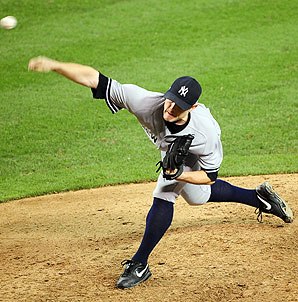
The Yankees’ David Robertson is a good example of above-average “extension.” He has an average fastball speed around 93 MPH, but he has an “extension” of 7 feet, making his effective ball velocity 95 MPH. But what does Robertson look like when he releases the ball?

Does that look like Robertson is “reaching” to you? If it does, it’s because the trunk is forwardly flexing after ball release. What’s actually happening is that Robertson’s release point is closer to the plate because he has a long stride and he is not squared up to the plate. Robertson has rotated his upper trunk to position his pitching arm shoulder closer to home plate, and these factors in combination are what cause the “extension” everyone wants.
Summary
Teaching effective and efficient mechanics is not easy. Trying to reduce it to a set of cues or checkpoints ignores the fact that the two rotational engines in the body will feel “chaotic” in the right delivery, and it’s not about controlling the chaos, but rather using the chaos effectively to produce the best fastball velocity the body can get.
Don’t teach kids to square up, reach to the plate, and do towel drills. Research dating back to 1997 shows that it’s futile to do so.
How to Use the Glove Side in Pitching
There have been millions of words (literally) written about the glove side as it pertains to pitching mechanics. I’m not going to add much to that, as I think a simple video and an animated image can say a lot more about how you can use the front side effectively in rotational sports.
Rotational sports are all basically the same when it comes to generating power and speed-strength. High velocities of the distal body part in question (foot for kicking, hands for throwing/swinging) all require effective sequencing of the body’s muscles and limbs (what we call “mechanics”). When you show baseball players examples of pitchers with elite velocities (Tim Lincecum, Roger Clemens, Aroldis Chapman, etc), it’s a good teaching tool for sport-specific uses. However, oftentimes people can get overloaded or get conflicting advice when seeing athletes in the same sport as them. Like the people at the Titleist Performance Institute, I’ve found that generic examples of rotational velocity can help a person understand the simple mechanics of producing high rates of pelvic and shoulder rotational velocity without confusing them with specific details of their sport.
Growing up, I loved tennis. As a baseball player, it came naturally to me, since it’s a rotational sport that requires solid hand-eye coordination and uses the dominant hand in a forehand manner. Unsurprisingly, I had solid first serve speeds (about 100 MPH, which is good for a teenager but nothing special) combined with a terrible backhand. My favorite player growing up was Michael Chang, even though we had wildly different games – he was incredibly fast with a quick forehand and jumping two-hand backhand, and I was pretty slow with a powerful forehand and a laughably bad one-handed backhand.
At any rate, after recently reviewing some video of Chang (source), I realized that he is a perfect example of how rotational athletes use the front side (non-dominant shoulder/arm) to create high rotational velocities. His extremely quick forehand – while below-average in power on the ATP tour – was deceptive due to how “short” his mechanics were to the ball and how long he kept the front side closed, while still using it to create leverage for the dominant hand.
All of this is evident in this quick shot of his forehand:

See how he creates leverage using the front side? Sure, his lower body mechanics are nearly perfect, but those will go to waste unless the front side is adequately “disconnected” from the back side. The front side pulls the back side around in an effective sequencing of body parts to produce an extremely quick, short, and powerful forehand volley.
Think about how this applies to baseball pitchers. I’ll let you do the theorizing.
Biomechanics Explained: The Difficulty of Measurement
I wrote this for some friends of mine who had questions about biomechanics, and figured I’d share it here.
——-
I’ll start with an introduction to what it is I’m studying. Biomechanics is nothing more than the description of mechanics (using the physics definition) as applied to the human body. The study of physical bodies being displaced or subjected to force is rather thorough, and indeed it must be – very large buildings, bridges, machinery, weapons, and other constructions are subject to the myriad laws of the universe. However, when we apply “simple” concepts of velocity, acceleration, and torque to human bodies, things get very complicated for one main reason.
Difficulties in Measurement
Accurately measuring the velocity of a baseball in a pitcher’s hand as it is accelerated towards the plate isn’t too hard. Radar guns do a reasonable job, but high-speed videography can get an answer within a few tenths of a mile per hour. While not very “precise” from a scientific definition, for the purposes of the game of baseball, it’s more than good enough. It becomes more difficult when you start to measure acceleration, which is nothing more than the second derivative of position (velocity is the first, naturally). The ball is not simply being accelerated in the x-plane towards home plate by any pitcher – no, it’s not that simple. Pitchers have a curvilinear approach to the plate with their pitching hand and release the ball on a line tangent to the curvilinear path. Since the ball is being accelerated sideways/upwards in addition to forwards, you can see how this would be hard to model using a single camera, no matter what the sampling rate.