

Posts Tagged weightlifting
Compound Movements: Use Them!
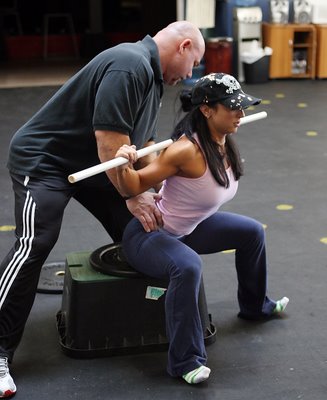
In your strength training regimen – be it off-season or in-season – you should be prioritizing compound movements. This means full-body exercises that utilize a lot of muscle mass in your prime movers. Good examples include the squat, deadlift, clean, snatch, bench press, press, pull-ups, chin-ups, rows, and many others.
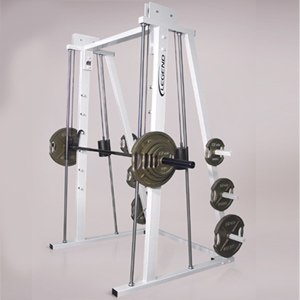
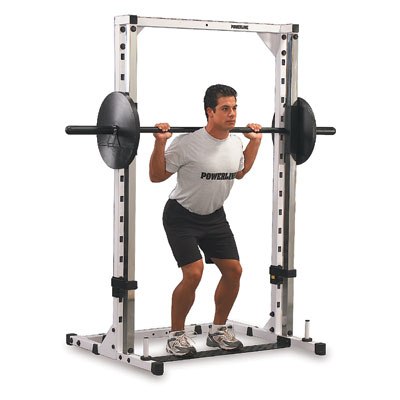
I would like to make it clear that these compound movements should absolutely not be done with machines. By using machines instead of free weights (barbells, dumbbells, plates, kettlebells, etc), you are giving your stabilizer muscles nothing to do; the machine controls the plane of movement rather than your bones, ligaments, tendons, and muscles. Additionally, you get less central nervous system (CNS) response from this type of work. Even worse: These machine-based “exercises” barely transfer over to athletic competition.
Staying away from machines is a good first step. However, there are plenty of “bros” in the gym who are doing equally silly things with dumbbells or barbells in order to pump up their “beach” muscles. Exercises like curls, leg extensions, lateral raises, and tricep kickbacks have no place in an athlete’s training program (with few exceptions for intermediate-to-advanced lifters). They simply do not stimulate enough muscle to gain appreciable strength, and the muscles they do work are worked in isolation, rather than an integrated movement.
Baseball does not use isolated movements in competition. In fact, very few sports do. Effective athletes learn to use their entire body efficiently to produce the most force possible to throw the ball harder, to hit a ball farther, to hit an opposing lineman harder, to jump higher for a rebound, and so forth. Isolating muscle groups has very little carryover to athletic competition – as such, these exercises should be used sparingly or omitted entirely.
Though I said I wouldn’t give out programs or workouts for free, I’ll show you what the offseason training for one of my clients (a HS Varsity infielder) has been over the past few weeks to show you that I practice what I preach:
- Monday: Back squat (3×5), DB Neutral-Grip Bench Press (3×5), Deadlift (1×5), Chin-Ups (3 sets to failure)
- Tuesday: Batting cage session
- Wednesday: DE Box squat (8×3), DB Push Press (3×5), Power Clean (5×3), Push-Ups (3 sets to failure), Light medball work
- Thursday: Volume medball work, Batting cage session
- Friday: Back squat (3×5), DB Neutral-Grip Bench Press (3×5), DB One-Arm Rows (2×10), One-Arm Suitcase Deadlift (2×5), Pull-Ups (3 sets to failure)
- Saturday: Skills day – grounders, flyballs, drills, etc. Agility/sprint training.
- Sunday: Light medball work and light long toss
On Wednesdays we’ll occasionally substitute the snatch for the clean depending on his progression, and we occasionally do full cleans with a jerk or substitute thrusters for more power output. The above program should be seen as a template that is flexible, but the overall message should not be lost – train for strength and power. It’s also worth noting that we do a comprehensive dynamic warmup with foam rolling (self-myofascial release) and mobility exercises before every workout, and some static stretching after it.
As we get closer to tryouts and the season, he’ll cut out Wednesday’s lifting session in favor of more sprint-based training, skills training, and a long run (2+ miles). I’m not a big fan of distance running for baseball players, but long-range cardio fitness has carryover to athletic competition, and his coach does like to make his players run long distances at practice, so he should be prepared for it – however dumb it may be.
A few pictures of the facility…
Here’s a few pictures of our strength and conditioning facility in North Seattle. Don’t mind the mess, we’re here to get work done. We never claimed that the facility was clean with TVs and treadmills. You come here to get strong and in-shape for the baseball season – nothing else!
More after the cut!
Misconceptions About Training Youth
Quick link this time: Here’s a great paper by Lon Kilgore, Ph.D. about the misconceptions many people hold about training youth athletes (PDF).
Should you wear a weight belt?
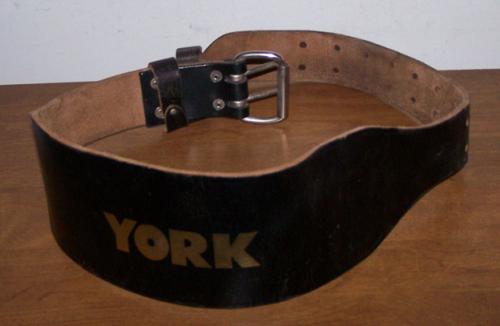
You’ve seen them in the weight room at your local globogym – big hulking dudes that look like bodybuilders with big belts in the back and small straps in the front. It might look something like this:

Typical belt seen at your local globogym.
The guys wearing these sweet belts are doing tricep pressdowns on the cable machine using the rope attachment, they’re doing curls with the 60 lb. EZ-curl bars, and they’re bouncing their bench press reps off their chest.
Let’s get one thing straight: These belts suck and so do the lifters who use them.
The reason that you use a belt is to give the abs something to push against – therefore making them work harder in the squat, deadlift, press, and bench press. The belt pictured above is small in the front, giving your abs basically nothing to push against! These belts are designed to “support the back,” which completely misses the mark on why you would use a belt in the first place. Gary Gibson on the Starting Strength message board put it very well:
The belt allows one to squat more weight NOT because it provides rebound…and not because the belt itself increases the necessary intra-abdominal pressure. The belt gives the abs something to push against so that the ABS THEMSELVES can provide more pressure. The belt just allows the abs to generate more tension by providing external resistance…just like a freaking weighted barbell on your back allows you to generate more tension than just flexing your lower body muscles really hard without the barbell as you stand up.
A journal article was printed regarding belts and their effect in both the conventional and the sumo stance deadlift. The results were:
Results: … Compared with the no-belt condition, the belt condition produced significantly greater rectus abdominis activity and significantly less external oblique activity.
Yep, as Gary said, the belt helps the abs work harder and it decreases the strain on the obliques – both good things!
Now, a proper belt will be 3-4 inches tall and 10mm thick all the way around – no taper. Most lifters should use a 4″ belt unless they have a short torso and less than normal room between the top of their ribcage and the iliac crest, in which case a 3″ belt is probably best. 13mm thick belts are for super strongmen and powerlifters and take forever to break in and use, so they’re probably not something that is applicable for the average athlete.
I personally own the following APT belt:

This belt rules.
It’s a single-prong model, which is a lot easier to get on and off, and it was reasonably priced at $50 plus S&H from their website. I even had to return my first one because I mismeasured my belt size (it goes around your belly button, not your waist) and the exchange process was simple and easy.
You might want to get a belt tightener tool so you can wear the belt extremely tightly around the midsection. They look something like this:

However, these seemingly-simple tools cost about $40-50 from various stores online! It’s pretty expensive for a piece of metal. I will say that they are extremely useful, though – it’s very difficult to get the desired tightness around the midsection by yourself, and unless you have really strong friends, once you use this tool, you won’t go back (I feel this way myself).
So if your squat is stalling and you’re at the end of your novice program, it might be time to invest in a nice belt. I use an APT belt, but there are a lot of good companies – many of my friends use Inzer with great success. Just be sure to get a single-pronged (or lever) belt that’s 10mm thick and 4″ tall unless you have a short torso.