



Posts Tagged plyometrics

Link/Video: Mariners Strength Program

The Seattle Mariners have switched from a generic strength and conditioning program to a “high-tech” advanced program by Dr. Marcus Elliot. Many articles on the switch have talked about the lack of weights in the weight room and the emphasis on plyometric/movement training, leading many to believe that weights were completely left out of the program altogether. As the video below shows, this isn’t exactly the case:


As you can see, they have a significant amount of cable pulleys with variable resistance to train hip rotation, a rack of dumbbells, and three power cages with a variety of barbells. While this doesn’t constitute a “lack of weights” by anyone in the know, I’m willing to bet most reporters were used to seeing a bunch of isolation-based machines and equated them as “weight training.”

As Dr. Marcus Elliot so succinctly points out, training hip rotation is extremely important in baseball athletes. He also goes on to say that athletes must train their legs for strength and also mentions the need for improved thoracic extension. Improving tissue quality via self-myofascial release (SMR, also known as foam rolling) and performing postural exercises that address these needs is extremely important in a baseball training program.

I’m glad to see a major-league organization that “gets it” and doesn’t have their guys training on machines like most other organizations do. The attention to thoracic extension, hip rotation, and leg strength (just to name a few things I like about the program) are all very good and necessary if you want to effectively train baseball athletes.

, , , , , ,

4 Comments

Appropriate Energy System Development

(Alternate title: Why running long distances is a bad idea for baseball pitchers.)

As high school tryouts commence and spring training games begin, pitchers all over the nation are running poles after they throw their long toss or their bullpens. Coaches are making their kids run 30 minutes at the end of tryouts just to gauge “fitness” and weed out the bad apples, assuming the ones who can’t display shows of endurance over long runs are not fit to play baseball. This practice has got to stop.

The common arguments on both sides of the aisle are:

  • Pro-long distance running: It builds endurance for pitchers and helps them to pitch longer into games!
  • Anti-long distance running: When’s the last time you ran the ball across the plate?

While the second argument is a bit more funny, it doesn’t address the logical fallacies of the first argument. As such, this ends up being a circular argument and neither side gets much done.

At best, long distance running is mildly useful to the completely untrained athlete (and remember what I said about untrained athletes in my post about P90xanything works, but that doesn’t make it a good idea) to extremely detrimental for advanced athletes. The most likely result of running long distances is simply wasting the athlete’s time when he can be doing more sport-specific work or training in more efficient ways.

Eric Cressey wrote a post about this subject, but I’d like to go more in-depth on the topic he covered with this statement:

Reason #6: Inappropriate Intensities

In what was – at least in my eyes – a landmark study, McCarthy et al. (1995) looked at “compatibility” of concurrent strength training and endurance training.  Traditionally, the attenuation of strength and power gains has been a big issue when endurance exercise is added to a strength training program.  As I noted in Cardio Confusion, these researchers found that strength and power loss was only an issue when the intensity of the endurance exercise was greater than 75% of heart-rate reserve (HRR) (4).  I can guarantee you that the majority of pitchers who are running distances are doing so at well over 75% HRR.

As I’ll note in my recommendations at the conclusion of this article, I strongly feel that the secret is to stay well above (circa-maximal sprinting, in other words) or below (70% HRR, to play it safe) when implementing any kind of running.  The secret is to avoid that middle area where you don’t go slow and don’t go fast; that’s where athletes get SLOW!  And, ideally, the lower-intensity exercise would be some modality that provides more mobility benefits.

“Inappropriate intensity” is the exact phrase I use all the time with my pitchers (and coaches I talk to) in explaining to them that long-distance running is a giant waste of time for them. The metabolic energy systems can be viewed as a spectrum: On one end, we have aerobic training that utilizes triglycerides and oxygen to fuel a workout that is long in duration. On the other end, we have two types of anaerobic training that utilizes creatine phosphate or glycolysis to regenerate/recycle ATP (adenosine triphosphate). ATP is the very source of energy – remember that!

For very intense and short duration efforts – 40 yard dash, throwing a fastball, a set of 5 squats – ATP is recycled by creatine phosphate. This is commonly called “anaerobic” work. But remember, there are two types of anaerobic “training.” For efforts that are intense but slightly longer in duration – 400m dash, a set of 20 squats – glycogen molecules are broken down into glucose (glycogenolysis) and eventually turned into ATP for energy. For efforts low in intensity and long in duration – long-distance running/jogging/cycling – ATP is produced through a complicated series of events called the Krebs cycle which essentially transforms fatty acids into ATP with the use of oxygen.

Whew! If you made it this far, you can already probably tell that aerobic training is not specific to baseball pitchers (or hitters, actually) at all. All efforts in baseball involve short bursts of intense effort – throwing a fastball, swinging a bat, stealing a base, bolting after a line drive hit in the gap, fielding a one-hop sharp grounder, throwing to first base, picking a ball out of the dirt, sprinting to cover home plate… you get the idea.

Interestingly enough, training a baseball player’s energy systems are very similar to training a sprinter’s energy systems – we use plyometric jump boxes, short ladder sprints, interval training (on the AirDyne, Concept2 rower, or just sprint intervals), and our favorite new toy, the weight sled:


So believe it or not, training to reduce your 60 yard dash time, 20 yard shuttle time, and jack up your vertical leap (3 out of 4 of the metrics on the SPARQ Baseball test, by the way) will go a long way in making you a better baseball player… and could increase your VO2max better than long-distance running could!

“What,” you say? “You just said that training anaerobically was the best way to train a baseball player… how could that increase an aerobic metric like VO2max?”

Enter… the Tabata Training Method. In a groundbreaking study published in 1996, a Japanese exercise scientist named Dr. Izumi Tabata concluded that “…moderate-intensity aerobic training that improves the maximal aerobic power does not change anaerobic capacity and that adequate high-intensity intermittent training may improve both anaerobic and aerobic energy supplying systems significantly, probably through imposing intensive stimuli on both systems.”

This meant that running long-distances with moderate intensity didn’t help anaerobic efforts, but interval training (20 seconds max effort, 10 seconds rest for 4 minutes as Dr. Tabata defined it) not only improved both energy systems, but that interval training was better at improving VO2max than simply training with moderate intensity efforts!

We’ll talk more about Tabata methods and interval training in a future post, but what you need to know is that long-distance running isn’t going to help you last longer on the mound because “endurance” is specific to the task. Maybe those guys saying “you don’t run the ball across the plate” had something after all…

, , , , , ,

No Comments

Overtraining: A Serious Problem

Stop me if you’ve heard this before: Conditioning month is meant to bring out the best in the high school athlete. It’s a punishing routine, often run twice per day at obscene hours (5 AM morning session, 6 PM evening session) where the men are separated from the boys. The morning session involves running 2 miles to “warm up,” followed by intense 100 meter sprints and other plyometric work. Puking is common and is taken as a sign that the workout is hard enough and the coach is doing his job.

In the evening, the players convene for skill work – the soccer players run hours of foot skill drills, exhausted from the morning session, while the football players practice hitting and tackling if they’re not in the weight room performing quarter-squats with 600 pounds on their back. Basketball players are running ladders, suicides, testing their vertical leap, and jumping over plyometric hurdles – all the while feeling a burning sensation in their shins but unwilling to speak up to the coach about it. Because after all, no one wants to think that you’re not tough enough, right?

Wrong.

High school coaches are singlehandedly responsible for dogging their athletes and pushing them well past their physical, mental, and psychological limitations. The ones who succeed on these absurd five-day-a-week programs with four or more hours of intense work are the genetic freaks, the ones who are truly the outliers. The ones who fail and suffer injuries are deemed “weak” and not worthy of making the team. The rest plod through it, nursing their “soreness” (in actuality, these are injuries), icing their bodies, and sleeping for hours on end, hoping the pain will go away in time for the season to start. Training is not like a game at http://www.casino.com/ or sitting in an armchair reading a book – the human body has limits. This ‘eggs against the wall’ training philosophy, where throw enough eggs against a wall and hope that one will end up at the Olympics (but forget about 5,000 that you wrecked), has serious shortcomings. Athletes lose 30 pounds in a month, slash their 40 yard dash time, and increase the weights on their squats that closely resemble a bad leg press rather than a true full squat. Progress was made – the ends justify the means.

Wrong.

High school athletes are often rank novices – they are thoroughly unadapted to stress and can be pushed to their limit every time they train because they have no previous experience! Novices do not get stronger when they train, they get stronger when they recover. Overtraining is when you push an individual past his limitations and do not respect the time it takes to recovery from a workout that disrupts homeostasis. Overloading is when you design a program that disrupts homeostasis – good programs overload, but do not overtrain.

An example of an excellent novice program is that of Mark Rippetoe’s Starting Strength – the novice lifter works every other day, increasing the weight on all of his lifts (Back Squat, Press, Bench Press, Deadlift, Power Clean) every session. This is the linear progression model. The athlete gets one day off between workouts and two on the weekends, though adding a “metabolic conditioning” workout on one of those days is not a terrible idea (as long as there is one day of recovery before the next heavy lifting day).

Training for Novices (aka High School Athletes)

The ideal novice training cycle looks something like this:

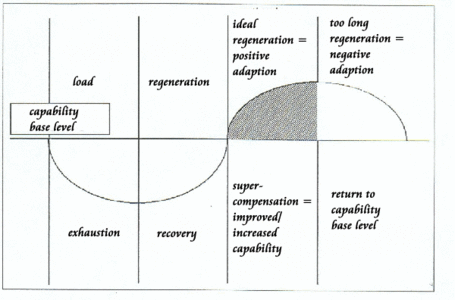
  1. Load phase. This leads to exhaustion and a disruption in homeostasis.
  2. Recovery phase. This allows the body to recover and rest.
  3. Supercompensation phase. This is where the body gets stronger and adapts to the stresses placed on it in the Load phase.

The first step is then repeated. However, if the load phase is started too late after supercompensation, then the effects are mitigated and the athlete may return to the base level of fitness. Confused? This excellent graph from Footballdrills.com should help:

Supercompensation_medium

More after the jump…

Read the rest of this entry »

, , , ,

1 Comment