


Posts Tagged myths
Locating Up in the Zone – Better for Amateur/Recreational Pitchers
Posted by Kyle Boddy in Articles, Sabermetrics on May 14, 2012
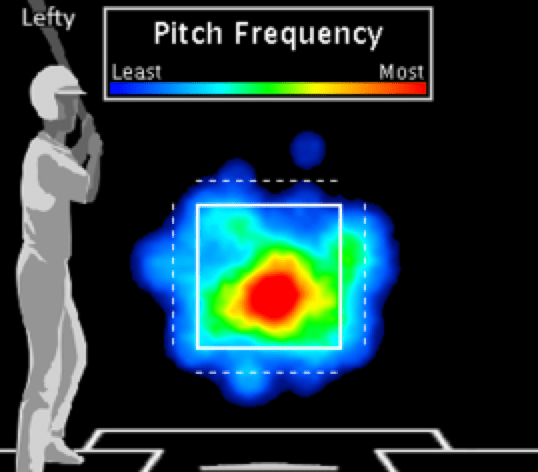
Pitchers at all levels of the game are told to locate their pitches in the bottom half of the zone so they can get hitters to swing over the top of the pitch and produce ground balls. As everyone knows, ground balls are the best way to prevent runs, since you can’t hit ground balls over the fence and it’s tough to hit them into the gaps for extra bases. Apologies to all coaches of youth, high school, and many college pitchers, but: You’re wrong. Pitchers should locate their fastballs and breaking balls in the top half of the zone to get the most success when competing against average youth, high school, and most college hitters.
Ground Balls: Be Careful What You Wish For
It’s happened to everyone – including me - you get a ton of ground balls, your defense boots the ball around, you end up giving up 1 or 2 earned runs but a plethora of unearned runs. When your coach comes and pulls you from the game, he says: “Nothing you could have done, kid. Defense just didn’t play behind you,” pats you on the butt, and tells you to get your running in.

Bad luck. Or was it?
Your teammates apologize for booting that easy ball in the hole, for not picking that ball at first base, and dropping that easy double play opportunity. Being a good teammate, you say “Ah, it happens. Get ‘em next time.” Then while running your poles, you reflect on how particularly unlucky you were that day. If only Bobby hadn’t lost that ball in the sun and Roger didn’t sail that ball from shortstop, you would have gotten out of that long inning. But were you unlucky? Think about it: You did everything you were supposed to – get a few strikeouts, not walk too many, and got a lot of ground balls. And what were you rewarded with? Hasn’t this happened before? What if you got fly balls instead? Don’t hitters swing and miss on your fastballs up in the zone – and when they make contact, don’t they often go for fly ball outs? How many home runs does the entire school have, anyway? Four? But what’s the team batting average – .380? Here are the two major reasons you want to get ground balls at the MLB level:
- Sluggers often hit fly balls over the fence.
- Defense at the MLB level is insanely elite.
Think about those reasons for a minute. Do either of those reasons apply to your high school league? What do you think the average HR rate on fly balls is in your league? I guarantee it’s not 11%. (MLB Average HR/FB rate.) We’ve already established defenders at the HS/College level are orders of magnitude worse than the Dominican and Venezuelan infielders of MLB (to say nothing of the local product), so why are you applying a heuristic to a completely different game?
Tons of data and a shattered myth after the jump… Read the rest of this entry »
Myth: Strength Training is Not Specific to Baseball Pitching
Posted by Kyle Boddy in Training on September 15, 2010
This myth has been perpetuated throughout baseball, from the lowest to the highest levels and all around the world. Frankly, it’s a load of BS. It’s very simple to understand without getting too deep into the physics of the movement, so we’ll keep it short.
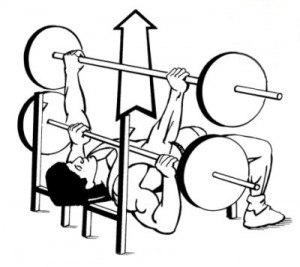
You can find no shortage of papers that cite that elbow valgus stress in the pitching motion can exceed 60 Newton-meters (Medscape), which is higher than the theoretical maximum loading ability of the UCL in cadaver-based studies. But what exactly does 60 Newton-meters mean? Well, 60 Newton-meters is roughly equivalent to 81.35 pound-feet of torque. One foot-pound force is equivalent to one pound of force acting at a perpendicular distance of one foot from a pivot point. So, if you moved a one pound object exactly one foot in the air perpendicular to the force, that qualifies. A simple example is the bench press:
It’s not perfect, since no lifter moves the bar exactly perpendicular to the body, but it’s close.
Critics often say that the bench press doesn’t contribute to release velocity or injury prevention because a baseball weighs 5 ounces while a bench press is far greater. The truth, of course, is that the actual weight does not matter. Your body doesn’t care if an object weighs 5 ounces or 200 pounds – it cares what the raw force acting upon the body is!
Since we know that releasing a baseball can create up to (or even exceed) 81.35 pound-feet of torque, let’s do some simple math to see how much force a 135 lb. bench press creates. Keeping it very simple, let’s assume that the bench press moves 12 inches in the concentric direction roughly perpendicular to the action of force. This would mean that a single rep of the bench produces 135 pound-feet of torque per concentric repetition!
Consider that the higher values in the bench press do not exactly mimic the force the elbow undergoes, since more muscle groups are involved in the bench press. Think about which large muscle groups in the shoulder/arm are firing to create release velocity – not many! Therefore, the muscles in the shoulder/elbow undergo a proportionally higher load than the larger muscle groups in the bench press – or squat, deadlift, barbell row, or any other weight room exercise.
The myth that strength training is useless because the baseball only weighs 5 ounces is nothing short of stupid. The load per contracting muscle fiber that the elbow/shoulder experience far exceeds the amount of force that average lifters will experience in their compound movements.
Strength training plays a large part in keeping a baseball pitcher healthy and helping to improve his release velocity. By strengthening the segments that sequence together to throw a ball hard (largest to smallest, proximal to distal), pitchers can increase their fastball velocity. And by strengthening the decelerators, pitchers can safely do so as well.
Train for strength. Don’t listen to the people left behind in the 1960′s. Train at Driveline Baseball.