
Archive for May, 2011
Doug Fister, Velocity, Strikeouts, and Hard Work
Seattle Mariners’ starting pitcher Doug Fister is well-known for being a soft-tossing righty who gets guys out as a control/command pitcher. Except, in 2011, that’s not necessarily true. Fister’s average fastball velocity is up over 1 MPH in 2011 when compared to 2009 and 2010, and this doesn’t even control for the fact that pitchers as a whole have slower fastball velocities in the early months of the season. (Nor does it control for weather, which plays a role – and we’ve had inclement weather this year.)
Geoff Baker of the Seattle Times interviewed Doug Fister briefly, where Fister said:
“I have been putting in a lot of work in the weight room,” Fister said. “I’ve spent a lot of time lifting, conditioning and throwing. So, yeah, I feel a lot stronger this year. I’m in good shape. We’ll see where it takes us.”
On Monday’s start, Doug Fister’s four-seam fastball was around 91-93 MPH and not 88-90 MPH. What’s the difference between those two numbers? A huge jump. Fastball velocity does not follow a linear curve; the difference between an 88 MPH fastball and a 93 MPH fastball is not the difference between an 80 MPH fastball and a 85 MPH fastball. It’s a much larger – and more effective – improvement. Fastball velocity is positively correlated with strikeout rate at the major league level, and so every tick a pitcher can pick up makes a huge difference. It might mean the difference between staying in the big leagues and being demoted to the minors, never to return.
While we don’t know exactly what Doug Fister was doing for his strength, conditioning, and throwing program, we know he’s been doing more of it. And we also know that the Seattle Mariners use Dr. Marcus Elliot’s programs for many of their athletes, which revolves around free weights, medicine balls, and integrating biomechanical analysis concepts into their training methodologies.
Train Hard, Throw Hard
Pretty simple conclusion – if you train hard, you’ll throw hard. Consider that Doug Fister is an elite baseball athlete already flirting with 90 MPH and yet he was able to add velocity by simple training harder. What kind of improvements can the average prep/college pitcher make if he got on a smart training program and worked his butt off?
Flat curve ball? Stop throwing strikes!
A common problem with pitchers of all ages is the inability to control their curveball. Sometimes it’ll be great, and sometimes it’ll come out of their hand flat. (I have this problem myself!) Most of the time the problem revolves around the pitcher throwing the ball to the target and not focusing on the quality of the pitch. This happens with fastballs too, but the fix is different – and a topic for another blog post.
Pitchers think too much about throwing their curveball for a strike. What you can do to help increase both the quality and consistency of your curveball is to stop doing this in your bullpen sessions. Yes, your bullpen sessions should focus on throwing a high percentage of strikes most of the time, but you also need to work on pitch quality as well. This means throwing fastballs at maximum intensity without care for location to understand what it will take to tame that chaotic delivery, and it also means spiking curveballs in front of the catcher.
Find yourself a good catcher – who you’ll buy a milkshake for after you’re done beating him up – and have him set up normally in the middle of the plate (or slightly to the glove side if you throw a slurve). Do NOT throw curve balls for strikes, but instead deliberately throw them so they land a foot in front of the catcher. If you don’t have a catcher, you can just set up a net behind the plate and practice this – perhaps marking the target with some white athletic tape.
By working on the depth of your curveball, you ignore the pressures of throwing strikes and can instead just work on the pitch’s movement. Over a few bullpen sessions, slowly work this feeling back into your regular strike-throwing sessions and you’ll see that the control of your curveball will come back as you increase your confidence in the ability to throw it.
Why Have I Lost Fastball Velocity?
Pitchers at all levels can lose fastball velocity – the meal ticket – over a season and wonder to themselves: What’s the deal? If you’re one of those pitchers who is seeing a drop in velocity despite no mechanical changes and no apparent injury, I have a very simple answer for you: You don’t work hard enough in-season.
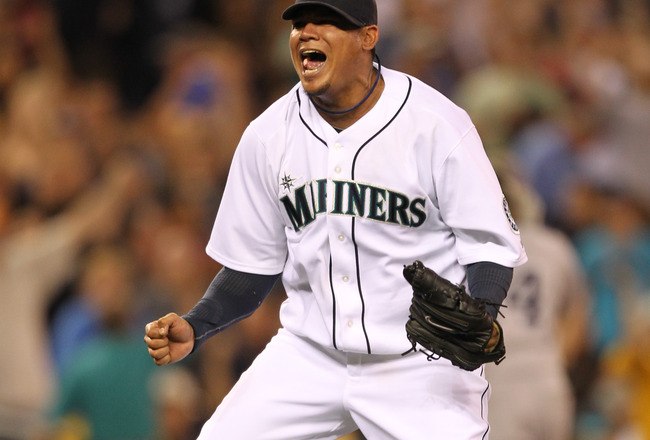
Consider what Cy Young winner Felix Hernandez does to prepare for his starts during the MLB season:
He’s special in that he plays long toss every day, and it’s not even the normal long toss. It’s almost an extreme long toss. He probably throws the baseball about 280 to 300 feet. For the most part you see guys go out — the longer guys — 200 feet, maybe 225 feet. In his case, he throws the ball with a lot of height — he really gets a lot of air under it — and what he’s accomplishing is not only strength, but also extension. It’s a bit far, but hey, you can’t argue with the success he’s had.
(source: Fangraphs)
If you want to reach your ceiling for fastball velocity, you need to throw a LOT of fastballs. This concept doesn’t seem hard to understand, but it’s often overlooked by pitching coaches in an attempt to “protect” a pitcher’s arm. I’ve seen recommendations on baseball forums to not lift weights the day after you pitch and not to throw too much in-season to conserve the bullets in the arm. This logic is exactly backwards, and it leads to more arm-related injuries and decreases in effectiveness/velocity rather than protecting a pitcher.
Human physiology doesn’t work the way the proponents of “rest” think it does. Humans have the amazing capacity to adapt to many different types and frequencies of stress. Pitchers should gradually throw more and more frequently and with more volume as they can tolerate it, and ideally should be throwing a baseball six days per week – including in-season work – to develop the necessary fitness and endurance to compete at the highest level.
Throwing – not pitching – more frequently does many good things:
- Conditions and develops the structures in the pitching arm
- Helps the developing pitcher work on his mechanics to feel the changes necessary to throw harder
- Aids in improving control
If all you do as a pitcher is throw one bullpen session and one start per five days, you’re missing out on development opportunities to improve.
You must learn to throw the ball before you can adequately pitch it, and you can’t develop that ability without throwing in a non-competitive situation – and this includes bullpen sessions.