
Archive for March, 2010

Link/Video: Mariners Strength Program

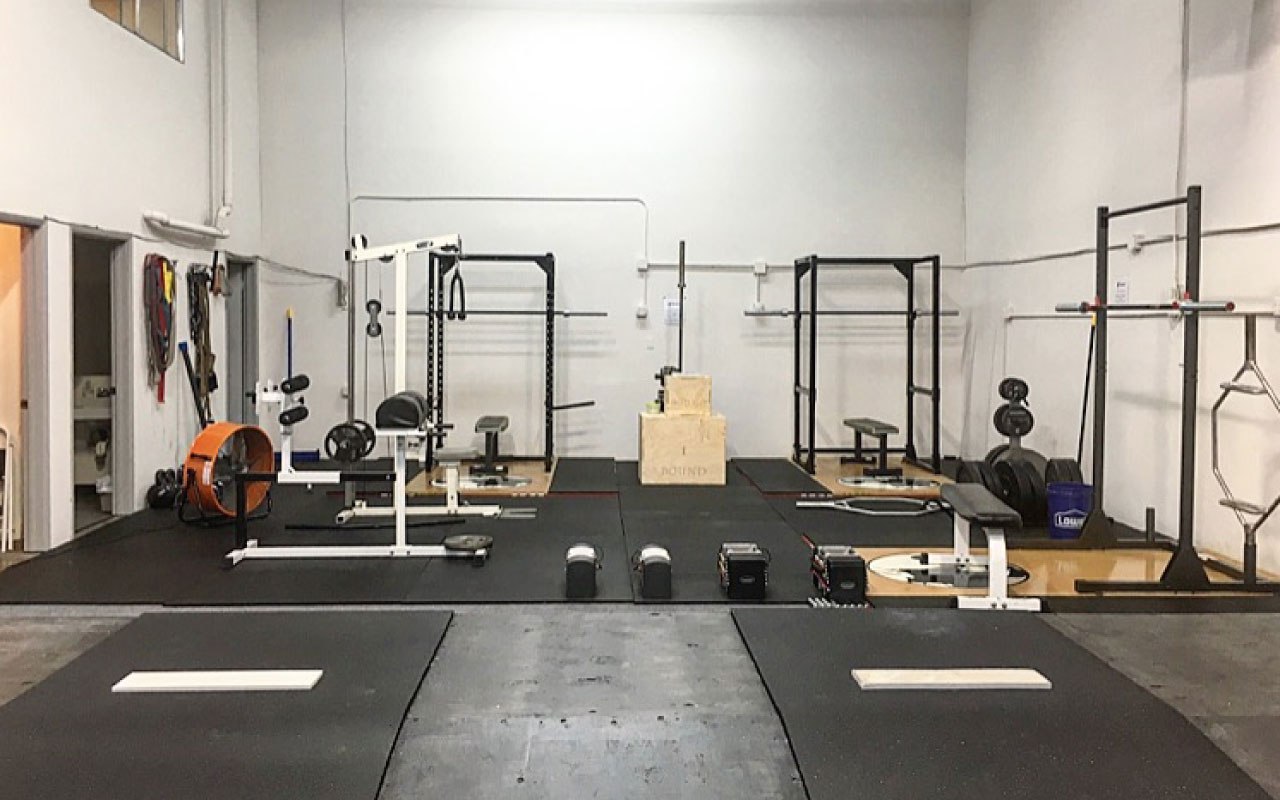
The Seattle Mariners have switched from a generic strength and conditioning program to a “high-tech” advanced program by Dr. Marcus Elliot. Many articles on the switch have talked about the lack of weights in the weight room and the emphasis on plyometric/movement training, leading many to believe that weights were completely left out of the program altogether. As the video below shows, this isn’t exactly the case:


As you can see, they have a significant amount of cable pulleys with variable resistance to train hip rotation, a rack of dumbbells, and three power cages with a variety of barbells. While this doesn’t constitute a “lack of weights” by anyone in the know, I’m willing to bet most reporters were used to seeing a bunch of isolation-based machines and equated them as “weight training.”

As Dr. Marcus Elliot so succinctly points out, training hip rotation is extremely important in baseball athletes. He also goes on to say that athletes must train their legs for strength and also mentions the need for improved thoracic extension. Improving tissue quality via self-myofascial release (SMR, also known as foam rolling) and performing postural exercises that address these needs is extremely important in a baseball training program.

I’m glad to see a major-league organization that “gets it” and doesn’t have their guys training on machines like most other organizations do. The attention to thoracic extension, hip rotation, and leg strength (just to name a few things I like about the program) are all very good and necessary if you want to effectively train baseball athletes.

, , , , , ,

5 Comments

Link: College Pitching Injuries

Kevin Agee of The Standard at Missouri State University asks the question: “How would you handle the responsibility of owning what could be a multimillion-dollar investment in the future?”

Kevin interviewed Eric Cressey, the MSU coaches, the MSU pitchers, and me about college pitch counts and training collegiate pitchers in general. What follows is a well-written article that addresses some of the concerns of high-level amateur pitchers who may have professional aspirations. I was very pleased to read that the MSU coaches share many of the same views I have on training pitchers with regards to a strength and conditioning focus.

Check it out!

, ,

No Comments

In-Season Training: A Difficult Task

Strength and conditioning is tough enough in the offseason, but once you have to focus on practices, bullpens, batting cage time, skill development, and playing games, training for strength and speed becomes nearly impossible! I’m a huge supporter of youth athletes picking up multiple sports in their early years of high school – by all means, join the soccer team, lacrosse team, football team, and baseball team (of course). However, this diversity comes at a price: You can get good at all the sports and increase your overall fitness as a result, but you’ll rarely be great at any of them. Why? There’s no offseason to take your focus off performance and place it on training to increase general strength and conditioning.

kb-swing

Kettlebell Swings: Great conditioning work for any season

As you progress through high school, it’s worth analyzing what sports you really like and the ones you have some talent in. If you’ve got a shot to play college or pro baseball, you should seriously consider dropping the other sports so you can have a clearly defined workout program in the off-season to focus on your SPARQ Baseball metrics, overall bat speed, fastball velocity, fat loss, or just getting stronger and fitter.

When you have a clearly defined off-season and in-season timeline, I recommend focusing the bulk of your off-season work with high volume and high intensity weight training that’s hard to recover from. This type of training is inappropriate for in-season training but yields great benefits if you can set aside enough time to recover from the effects of the exercises. As you approach the competitive season, you should deload and switch your focus to skill work like taking grounders/fly balls, throwing long toss and bullpens, changing your pitching mechanics so you can throw harder and with less effort, examining your swing for flaws, and putting that increased strength and fitness to good use!

During the season, strength training will become very hard. If you’re in high school, you have 20 games with the school, plus playoffs, plus five practices a week, plus weekend practices or workouts with your select/travel team. Yikes! It becomes impossible to squat or deadlift heavy and recover from the effects of the training in enough time for the next game. Finding one day per week that you can lift heavy to maintain strength is your best bet, if possible.  Focusing on high intensity but low volume workouts (heavy triples in the squat and deadlift, for example) will help you maintain the strength levels you built up in the off-season without seriously impacting your recovery system in a negative manner.

Improving your sprint times and medball throws are goals you can focus on during the season, as these activities dovetail nicely with conditioning that’s done in-season with your team already and won’t tax you too much. Kettlebell swings are a great way to develop rapid hip extension power, provides a nice conditioning stimulus, and are easy to find time for!

, , , , ,

1 Comment

Mechanics: The Effects of Loading Rate

Just wanted to drop a short post in about loading rate as it relates to the humerus and possibly the connective tissue in the pitching arm during the throwing motion.

In Humeral Torque in Professional Baseball Pitchers, Sabick et al. concluded that “pitchers who elbows were more extended at stride foot contact tended to have lower peak humeral torques.”

So, in theory, an extended elbow at foot contact but prior to the maximum external rotation would decrease stress on the humerus. Remember that in Correlation of Throwing Mechanics With Elbow Valgus Load in Adult Baseball Pitchers by Aguinaldo et al. that increased elbow flexion was closely related to reducing valgus torque, so an extended elbow throughout the motion is not necessarily ideal.

elbow_valgus_load

Also notable is the fact that bone is sensitive to loading rate and not just peak values of stress – therefore, the faster and harder the humerus (and the connective tissue) is loaded, the more danger there is with regard to injury.

Many people focus on the total load and stress on the bone or connective tissue as the failure point of the body’s working parts and pieces, and indeed many laboratory (in vitro)  studies simulate only this variable. As Sabick et al. pointed out in the aforementioned paper:

Simply comparing dynamic pitching biomechanics data to bone strength data from in vitro studies is actually over-simplifying the problem. Bone strength is sensitive to loading rate. Differences between loading rates in the laboratory and those occurring during pitching suggest that the data are not directly comparable. In addition, simple torsion is generally simulated in laboratory tests, but the situation is much more complicated in vivo. There are additional components of force and torque acting on thehumerus at the same time the humeral torque peaks. All of the force and moment components contribute to the state of stress in the bone,which changes as a function of time.

As I have often said, Humeral Torque in Professional Baseball Pitchers is one of the most influential papers written about pitching biomechanics as it relates to how we train and instruct our clients. For more information, check out our Pitching Program and see if it’s right for you. As you talk to coaches and other instructors, ask them about the this paper, or simply ask them what research papers and scientific principles have guided their methods.

, ,

8 Comments