
Archive for December, 2009
Keeping Strength in the Strength Program
Bill Starr wrote an excellent article about prioritizing strength training in our sports. It’s a quick six-page read, yet it contains insightful wisdom that I wholly agree with and preach on a daily basis. Strength training is not easy, nor is it comfortable, but as Bill said himself in the paper, “Whenever you make a strength program easier, you will get weaker.”
Merry Christmas, everyone! With the HS season coming up soon, I hope you’re all on a good strength training program and have started to stretch your arms out! If not, get on that before the new year starts!
Overtraining: A Serious Problem
Stop me if you’ve heard this before: Conditioning month is meant to bring out the best in the high school athlete. It’s a punishing routine, often run twice per day at obscene hours (5 AM morning session, 6 PM evening session) where the men are separated from the boys. The morning session involves running 2 miles to “warm up,” followed by intense 100 meter sprints and other plyometric work. Puking is common and is taken as a sign that the workout is hard enough and the coach is doing his job.
In the evening, the players convene for skill work – the soccer players run hours of foot skill drills, exhausted from the morning session, while the football players practice hitting and tackling if they’re not in the weight room performing quarter-squats with 600 pounds on their back. Basketball players are running ladders, suicides, testing their vertical leap, and jumping over plyometric hurdles – all the while feeling a burning sensation in their shins but unwilling to speak up to the coach about it. Because after all, no one wants to think that you’re not tough enough, right?
Wrong.
High school coaches are singlehandedly responsible for dogging their athletes and pushing them well past their physical, mental, and psychological limitations. The ones who succeed on these absurd five-day-a-week programs with four or more hours of intense work are the genetic freaks, the ones who are truly the outliers. The ones who fail and suffer injuries are deemed “weak” and not worthy of making the team. The rest plod through it, nursing their “soreness” (in actuality, these are injuries), icing their bodies, and sleeping for hours on end, hoping the pain will go away in time for the season to start. Training is not like a game at http://www.casino.com/ or sitting in an armchair reading a book – the human body has limits. This ‘eggs against the wall’ training philosophy, where throw enough eggs against a wall and hope that one will end up at the Olympics (but forget about 5,000 that you wrecked), has serious shortcomings. Athletes lose 30 pounds in a month, slash their 40 yard dash time, and increase the weights on their squats that closely resemble a bad leg press rather than a true full squat. Progress was made – the ends justify the means.
Wrong.
High school athletes are often rank novices – they are thoroughly unadapted to stress and can be pushed to their limit every time they train because they have no previous experience! Novices do not get stronger when they train, they get stronger when they recover. Overtraining is when you push an individual past his limitations and do not respect the time it takes to recovery from a workout that disrupts homeostasis. Overloading is when you design a program that disrupts homeostasis – good programs overload, but do not overtrain.
An example of an excellent novice program is that of Mark Rippetoe’s Starting Strength – the novice lifter works every other day, increasing the weight on all of his lifts (Back Squat, Press, Bench Press, Deadlift, Power Clean) every session. This is the linear progression model. The athlete gets one day off between workouts and two on the weekends, though adding a “metabolic conditioning” workout on one of those days is not a terrible idea (as long as there is one day of recovery before the next heavy lifting day).
Training for Novices (aka High School Athletes)
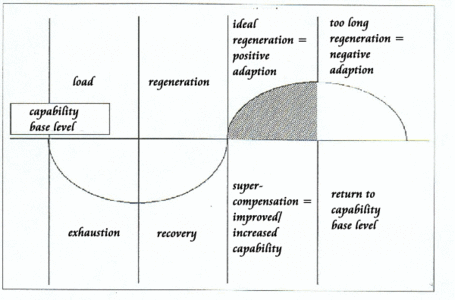
The ideal novice training cycle looks something like this:
- Load phase. This leads to exhaustion and a disruption in homeostasis.
- Recovery phase. This allows the body to recover and rest.
- Supercompensation phase. This is where the body gets stronger and adapts to the stresses placed on it in the Load phase.
The first step is then repeated. However, if the load phase is started too late after supercompensation, then the effects are mitigated and the athlete may return to the base level of fitness. Confused? This excellent graph from Footballdrills.com should help:
More after the jump…
Thomas Test – Applications in Baseball
This video is an excellent explanation of the Thomas Test as used by physical therapists around the world:
httpv://www.youtube.com/watch?v=9PLXyShrNDc
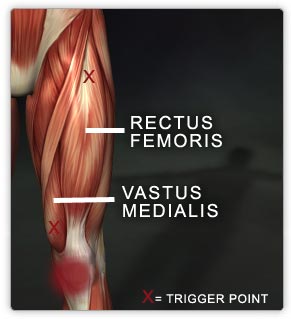
We will often perform this test on clients over the age of 16. While it is traditionally used to test for a fixed flexion deformity of the hip (and we do check for this), we use it with baseball players to test for a tight rectus femoris because of the single-leg dominance that occurs on the pitcher’s stride leg. (For an RHP, this is their left leg.)
During the lead leg block phase of pitching, the stride leg straightens very quickly and bears all the weight of the pitcher’s body. To get to that point, the pitcher will have used his posting leg hip adductors to stride sideways and closed to the target. If this sounds like a muscle imbalance and problems waiting to happen, you’re right!

Tim Lincecum at Lead Leg Block
The pitching motion typically causes tight hip flexors (moreso in the posting leg) and a tight rectus femoris in the stride leg. As a general rule, tight hip flexors mean weak glutes, which can cause postural problems and lowered power output in exercises like the squat. It can also cause diminished velocity, susceptibility to injury, and general discomfort. These problems are often exacerbated by the fact that many kids and adults spend most of their day sitting down – either at a desk in class or in a chair in front of a keyboard at work!
The Thomas Test helps identify which leg has deficiencies and to what degree they exist. We teach Self-Myofascial Release (SMR) at Driveline Baseball to help people loosen their hip flexors, regain strength in their glutes, and relax the fascia in various places in the body (a lengthier post on this subject is coming later).
Does your baseball coach understand the usefulness of foam rolling? Does he understand the differences between the stride and posting leg actions causing muscle imbalances? Does he know how to correct for it and also integrate SMR work in a good training program? If not, check us out for a cheap initial screening and analysis at our Training page. $25 gets you a session to check for muscle imbalances and postural problems as well as a personalized workout plan and how you can add some serious velocity to your fastball and stay healthy while doing so!
Misconceptions About Training Youth
Quick link this time: Here’s a great paper by Lon Kilgore, Ph.D. about the misconceptions many people hold about training youth athletes (PDF).
Are all novices the same?
In the world of exercise physiology and science, there are four levels of training – Novice, Intermediate, Advanced, and Elite. These levels represent the trainee’s ability to recover from workouts and adapt to the stress levels imposed on them by their training. Everyone who starts on a good strength training protocol will be a novice, even if they’ve bench pressed and curled a lot in their past. The amount of stress needed to produce an adaptation for a novice trainee is small enough that they can recover from in it 48 hours. They progress from workout to workout and require very basic programming.
Nearly everyone that I train has been a novice, and as such, they are all put on very similar programming. All novice trainees at Driveline Baseball will follow a program similar to Mark Rippetoe’s Starting Strength program with concessions and adaptations for baseball players (example: substituting dumbbell bench press for barbell bench press).

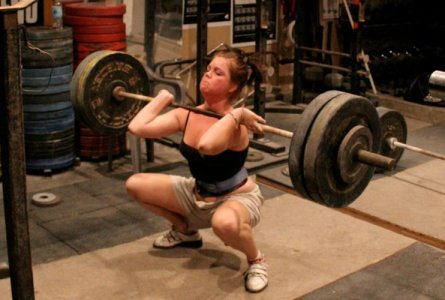
The front squat: Commonly used at Driveline Baseball.
All trainees will definitely perform some variant of the following exercises: Squat, Overhead Press, Bench Press, Deadlift, Row, and Chin-Ups/Pull-Ups. As an example of a squat variant, most of the pitchers will use the front squat, as this is a lot easier on the shoulders than the traditional back squat. Additionally, all trainees will perform some sort of Rate of Force Development exercise – speed squats, deadlifts, power cleans, power snatches, medball cleans, medball slams, and so forth.
In personal training, it’s very important to fit the programming to the individual. However, it’s also important to note that all novices are virtually the same when it comes to programming needs – they all require basic compound-lift-centric programming that they can recover from within 48 hours. Novices can recover quickly and make rapid gains, and to waste this precious time in the training cycle would be a grave error.
Concessions for individuals can be made based on sport-specific and anatomical needs – substituting the front squat for the back squat, for example – but trainers should never lose focus on the end goal: Rapid gains throughout the compound lifts that make up the majority of the program.
So, to answer this blog post’s question – Are all novices the same? – the answer is “Yes. For the most part.”
Should you wear a weight belt?
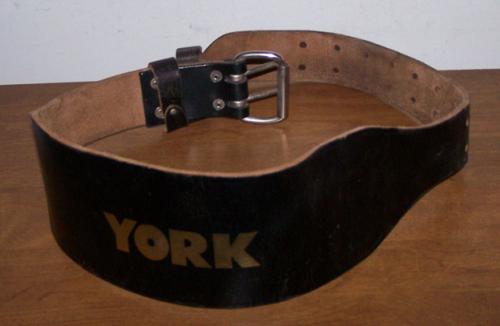
You’ve seen them in the weight room at your local globogym – big hulking dudes that look like bodybuilders with big belts in the back and small straps in the front. It might look something like this:

Typical belt seen at your local globogym.
The guys wearing these sweet belts are doing tricep pressdowns on the cable machine using the rope attachment, they’re doing curls with the 60 lb. EZ-curl bars, and they’re bouncing their bench press reps off their chest.
Let’s get one thing straight: These belts suck and so do the lifters who use them.
The reason that you use a belt is to give the abs something to push against – therefore making them work harder in the squat, deadlift, press, and bench press. The belt pictured above is small in the front, giving your abs basically nothing to push against! These belts are designed to “support the back,” which completely misses the mark on why you would use a belt in the first place. Gary Gibson on the Starting Strength message board put it very well:
The belt allows one to squat more weight NOT because it provides rebound…and not because the belt itself increases the necessary intra-abdominal pressure. The belt gives the abs something to push against so that the ABS THEMSELVES can provide more pressure. The belt just allows the abs to generate more tension by providing external resistance…just like a freaking weighted barbell on your back allows you to generate more tension than just flexing your lower body muscles really hard without the barbell as you stand up.
A journal article was printed regarding belts and their effect in both the conventional and the sumo stance deadlift. The results were:
Results: … Compared with the no-belt condition, the belt condition produced significantly greater rectus abdominis activity and significantly less external oblique activity.
Yep, as Gary said, the belt helps the abs work harder and it decreases the strain on the obliques – both good things!
Now, a proper belt will be 3-4 inches tall and 10mm thick all the way around – no taper. Most lifters should use a 4″ belt unless they have a short torso and less than normal room between the top of their ribcage and the iliac crest, in which case a 3″ belt is probably best. 13mm thick belts are for super strongmen and powerlifters and take forever to break in and use, so they’re probably not something that is applicable for the average athlete.
I personally own the following APT belt:

This belt rules.
It’s a single-prong model, which is a lot easier to get on and off, and it was reasonably priced at $50 plus S&H from their website. I even had to return my first one because I mismeasured my belt size (it goes around your belly button, not your waist) and the exchange process was simple and easy.
You might want to get a belt tightener tool so you can wear the belt extremely tightly around the midsection. They look something like this:

However, these seemingly-simple tools cost about $40-50 from various stores online! It’s pretty expensive for a piece of metal. I will say that they are extremely useful, though – it’s very difficult to get the desired tightness around the midsection by yourself, and unless you have really strong friends, once you use this tool, you won’t go back (I feel this way myself).
So if your squat is stalling and you’re at the end of your novice program, it might be time to invest in a nice belt. I use an APT belt, but there are a lot of good companies – many of my friends use Inzer with great success. Just be sure to get a single-pronged (or lever) belt that’s 10mm thick and 4″ tall unless you have a short torso.
Free Weight Squats > Smith Machine Squats
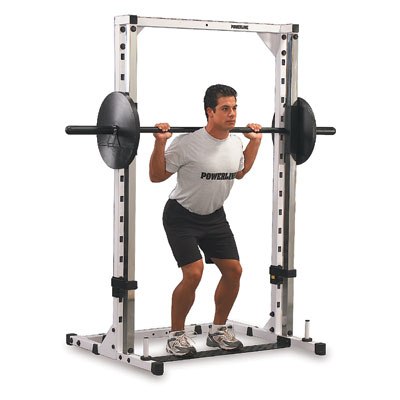
This is something the strength training community has known for awhile, but free weight squats are vastly better for performance training than smith machine squats. Additionally, since the Smith machine restricts your range of motion in one or more planes of movement (depending on the machine and exercise in question), it is inherently injurious as it leaves out the development of stabilizing muscles.

Don't use this. Also, this guy has terrible squat form.
Here is a study recently published that backs this up:
http://www.ncbi.nlm.nih.gov/pubmed/19855308
Electromyographic activity was significantly higher by 34%, 26%, and 49% in the gastrocnemius, biceps femoris, and vastus medialis, respectively, during the free weight squat compared to the Smith machine squat (p < 0.05). There were no significant differences between free weight and Smith machine squat for any of the other muscles; however, the EMG averaged over all muscles during the free weight squat was 43% higher when compared to the Smith machine squat (p < 0.05). The free weight squat may be more beneficial than the Smith machine squat for individuals who are looking to strengthen plantar flexors, knee flexors, and knee extensors.
…
The free weight squat may be superior to the Smith machine squat for training the major muscle groups of the legs and possibly would result in greater strength development and hypertrophy of these muscle groups with long-term training.
So get off those stupid machines and learn to train with free weights!